


By Shilpi Saurav Sharan and Huda Jafri
Introduction
As India marks ten years of the Startup India Initiative, the programme has evolved from a policy experiment into one of the largest and most geographically diverse startup ecosystems in the world. According to the latest data released by the Government of India in January 2026, over 2 lakh startups have been recognised by DPIIT as of December 2025, firmly positioning India as a global innovation hub.[1]
This scale, however, tells only part of the story. The deeper transformation lies in the institutional foundations that now support entrepreneurship, particularly the deliberate integration of intellectual property (IP) creation, protection, and commercialisation into the startup lifecycle.
Startups are inherently intangible-asset driven enterprises. Their valuation, investor appeal, scalability, and exit potential depend largely on patents, trademarks, designs, copyrights, and software. Recognising this reality early, the Government of India embedded IP facilitation within the Startup India framework, ensuring that innovation is not merely encouraged but legally secured and commercially deployable.
This article critically examines the IP-centric incentives and schemes introduced under Startup India over the last ten years, analyses filing trends and prosecution outcomes, and evaluates how these measures have reshaped startup behaviour, valuation, and global competitiveness.
Impact: IP Filing and Prosecution Trends
Over the last decade, the Startup India Initiative has coincided with a marked increase in intellectual property creation by startups and MSMEs, reflecting a growing recognition of IP as a core business asset rather than a peripheral legal formality. Government data indicates a steady rise in patent, trademark, and design filings, supported by statutory fee rebates, expedited examination, and professionally facilitated prosecution. This broader trend is also evident at the practitioner level, where IP facilitators empanelled under government schemes have assisted a significant volume of filings.
For instance, in furtherance of the SIPP Scheme, SS Rana & Co., with Mr. Vikrant Rana, Managing Partner, acting as a Startup Facilitator, has so far supported startups in filing, protecting, and enforcing over 2,400 IP applications, underscoring both the scale of IP adoption and the effectiveness of the Startup India–led IP facilitation ecosystem.
Startups patent application trends
| Year | Indian Startups (SU) | Foreign Startups (SU) | Total Startups |
| 2020–21 | 1,598 | 13 | 1,611 |
| 2021–22 | 1,482 | 19 | 1,501 |
| 2022–23 | 2,016 | 25 | 2,041 |
| 2023–24 | 2,546 | 25 | 2,571 |
| 2024–25 | 2,680 | 24 | 2,704 |
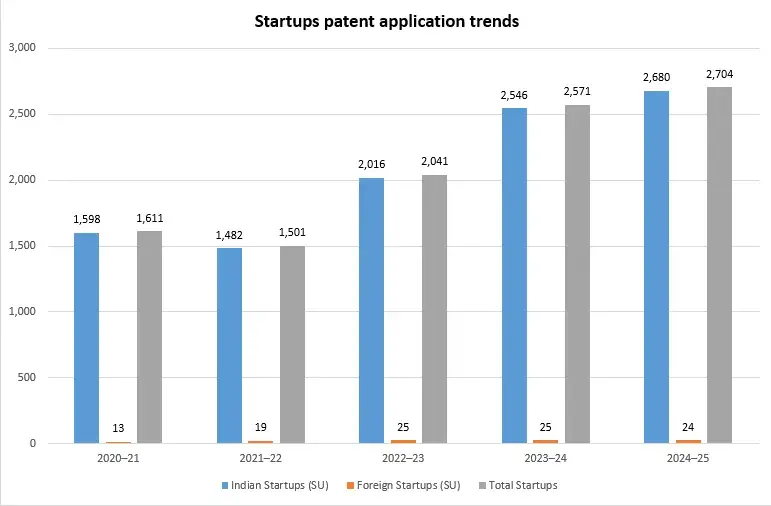
(Source: IP Annual Report 2024-25)
Requests for Expedited Examination u/r 24-C of Patent Rules
| Category of Applicant | Requests for Expedited Examination Filed | FER Issued | Patent Granted | Patent Refused |
| Startup | 4,151 | 3,626 | 2,254 | 371 |
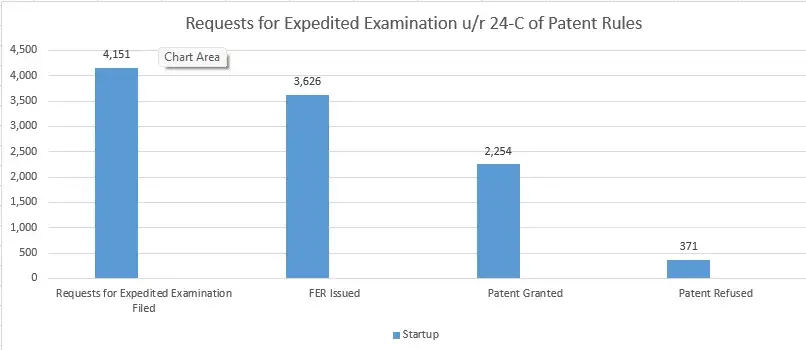
(Source: DPIIT Annual Report 2024-25)[2]
Startup India: DPIIT’s Central Role
The Startup India Initiative is led by the Department for Promotion of Industry and Internal Trade (DPIIT) under the Ministry of Commerce and Industry. Over the past decade, DPIIT has transformed Startup India from a policy-driven programme into a full-lifecycle support system spanning ideation, funding, mentorship, protection of innovation, and scale-up.
As per PIB data:
- India’s unicorn landscape has expanded from 4 unicorns in 2014 to over 120 unicorns by 2025,
- With a combined valuation exceeding USD 350 billion,[3]
- Reflecting the growing global relevance of India’s innovation economy.
From an IP standpoint, DPIIT’s role has been pivotal in:
- Granting startup recognition as a gateway to IP incentives
- Coordinating with the Office of the Controller General of Patents, Designs and Trade Marks (CGPDTM)
- Enabling statutory fee rebates and expedited examination
- Funding professional IP facilitation under dedicated schemes
Democratisation of Entrepreneurship and IP Creation
A significant structural shift highlighted in the PIB release is the geographical diffusion of startups:
- Nearly 50% of DPIIT-recognised startups now originate from Tier-II and Tier-III cities,[4]
- Demonstrating that innovation and IP creation are no longer confined to metropolitan hubs.
This decentralisation has direct IP implications:
- Increased patent filings from regional incubators and universities
- Growing trademark adoption by first-generation entrepreneurs
- Greater reliance on government-supported IP facilitation rather than private advisory models
State Startup Policies, now adopted by 31 out of 36 States and Union Territories,[5] play a crucial role in reinforcing this trend by offering:
- IP filing subsidies and reimbursements
- Support for technology commercialisation
- Incubation-linked patent and trademark assistance
IP-Related Government Schemes and Incentives for Startups in India
One of the most consequential outcomes of the Startup India Initiative has been the creation of a comprehensive intellectual property (IP) support framework that addresses cost, speed, access to expertise, and global competitiveness. Unlike earlier regimes where IP protection was largely founder-driven and cost-intensive, the present framework positions IP as a public-policy supported growth instrument for startups.
The IP-centric support ecosystem for startups in India operates across three distinct but interlinked layers:
- Statutory fee rationalisation and procedural fast-tracking
- Government-funded professional facilitation and prosecution support
- Domestic and international reimbursement-based financial assistance
These benefits are primarily administered through the Department for Promotion of Industry and Internal Trade (DPIIT) in coordination with the Office of the Controller General of Patents, Designs and Trade Marks (CGPDTM) and sector-specific ministries.
- Scheme for Facilitating Startups Intellectual Property Protection (SIPP)
The SIPP Scheme, introduced in 2016 under the Startup India Action Plan, constitutes the cornerstone of IP protection for DPIIT-recognised startups. The scheme was designed to address four structural barriers historically faced by startups:- High professional costs of IP prosecution
- Limited access to specialised IP expertise
- Procedural complexity
- Long timelines for grant of rights
1.1 Government-Funded IP Facilitators
Under the SIPP Scheme, startups are entitled to the services of empanelled IP facilitators, whose entire professional fees are borne by the Central Government. Startups are required to pay only the statutory/official fees prescribed under IP laws.
Scope of facilitator services includes:
- General advisory on patents, trademarks, and industrial designs
- Drafting of provisional and complete patent specifications
- Filing of patent, trademark, and design applications
- Prosecution, including responses to examination reports
- Representation at hearings before IP offices
- Handling pre-grant and post-grant oppositions
- Ensuring final disposal and grant/registration
Importantly, there is no numerical cap on the number of IP applications a startup may file under the scheme.
1.2 Statutory Fee Rebates for Startups
A critical incentive under SIPP is the significant reduction in statutory fees, placing startups at par with individual applicants.
TIMELINE OF EVENTS Type of IP Right Rebate Available Effective Official Fee Patents 80% reduction ₹1,600 (application) Request for Examination (Patent) — ₹4,000 Expedited Examination (Rule 24C) — ₹8,000 Trademarks 50% reduction ₹4,500 Industrial Designs 75% reduction ₹1,000 These rebates substantially lower entry barriers and encourage early-stage IP filing, often at pre-revenue or prototype stages.
1.3 Expedited Examination of Patent Applications
DPIIT-recognised startups are eligible to seek expedited examination of patent applications under Rule 24C of the Patent Rules.
Key advantages:
- Priority examination over ordinary patent applications
- Faster issuance of First Examination Reports (FERs)
- Accelerated prosecution and grant
- Earlier enforceability and monetisation of patent rights
In practice, this mechanism has reduced patent grant timelines from five to seven years to under 12–18 months in many cases, which is critical for:
- Fundraising
- Licensing negotiations
- Market entry and exclusivity
- Support for International Patent Protection
The Support for International Patent Protection in Electronics and Information Technology (SIP-EIT) scheme represented India’s first structured attempt to financially support overseas patent filings by startups and MSMEs.While the scheme was originally operational during the mid-2010s, its design has had a lasting influence on India’s international IP support philosophy.Key features:- Reimbursement up to ₹15 lakh or 50% of total expenses, whichever was lower
- Coverage across:
- Direct foreign filings (post-Section 39 compliance)
- Convention applications
- PCT route filings
- Staggered reimbursements linked to filing, examination, and grant
The scheme enabled startups to:
- Build international patent portfolios
- Enhance global valuation and investor confidence
- Protect export-oriented and deep-tech innovations
- MSME Innovative Scheme
Recognising that many startups transition into MSMEs while remaining IP-intensive, the Government introduced the MSME Innovative Scheme, which includes a dedicated IPR reimbursement component.3.1 Eligibility- Valid Udyam Registration
- IP registered in the name of the enterprise or eligible individual founder
- Declaration of non-duplication of government funding
3.2 Maximum Reimbursement Limits
TIMELINE OF EVENTS IP Asset Maximum Financial Assistance Foreign Patent ₹5.00 lakh Domestic Patent ₹1.00 lakh Geographical Indication ₹2.00 lakh Design Registration ₹0.15 lakh Trademark Registration ₹0.10 lakh This scheme ensures continuity of IP protection incentives beyond the startup phase, supporting scale-ups and growth-stage enterprises.
- Institutional and Ecosystem-Level IP Support Measures
In addition to direct financial and procedural incentives, the Startup India ecosystem includes several structural IP-enabling mechanisms, such as:- Capacity-building and IP awareness programmes conducted by DPIIT and CGPDTM
- Integration of IP evaluation into incubation and seed-fund frameworks
- Alignment with National IPR Policy objectives, including enforcement and commercialisation
- Encouragement of IP-backed collaborations between startups, academia, and industry
These measures have helped normalise IP ownership as a baseline business practice, rather than an exceptional legal strategy.
Conclusion:
A decade after its launch, Startup India represents more than numerical growth. It reflects structural transformation, from policy intent to execution, from metro-centric innovation to regional inclusion, and from informal creativity to formal, enforceable intellectual property ownership.
As India advances toward Viksit Bharat 2047, intellectual property will remain central to:
- Startup valuation and exits
- Technology transfer and global integration
- Employment generation and inclusive growth
India’s startup success story is not driven by ideas alone, but by ideas that are protected, commercialized, and scaled through a robust intellectual property ecosystem.
Our Coverage on LinkedIn: https://www.linkedin.com/feed/update/urn:li:activity:7417896556693041152
[1] https://www.pib.gov.in/PressReleasePage.aspx?PRID=2214872®=3&lang=2
[2] https://www.dpiit.gov.in/static/uploads/2025/06/3d9c9c2daeefb97bb9ce964370938b71.pdf
[3] https://www.pib.gov.in/PressReleasePage.aspx?PRID=2214872®=3&lang=2
[4] https://www.pib.gov.in/PressReleasePage.aspx?PRID=2214872®=3&lang=2