


By Ananyaa Banerjee and Titiksha Sinha
In the fashion world, people constantly walk a thin line between being inspired by someone else’s work and straight-up copying it. For independent designers, it gets even tougher, as they often do not have big legal teams or tons of resources, but their work still gets picked up sometimes unfairly by global brands.
Therefore, in the rapidly globalizing fashion industry, the protection of traditional and artistic designs faces unique challenges, particularly when IP rights cross national boundaries. This article examines the plagiarism allegations by Indian designer Anupamaa Dayal against Argentine brand Rapsodia, analyzing the legal frameworks applicable in India and abroad. The case illuminates the systemic vulnerability of independent designers in protecting their aesthetic innovations, especially where cultural expression meets commercial exploitation.
Background
Anupamaa Dayal, recognized for her vibrant ethnic prints inspired by Indian botanicals, alleged that several of her signature designs were copied and commercially exploited by Rapsodia. The allegation emerged after a delegation from Rapsodia, including a representative named Gunjeet Kaur, visited Dayal’s Delhi studio under the pretext of exploring Indian fashion. Subsequently, similar designs appeared in Rapsodia’s global product catalog and social media content.
Upon confronting the brand, Dayal was reportedly asked to furnish registered IP documentation. Following this, Rapsodia’s social media became inaccessible to Indian users, and its website was geo-blocked in India, circumstances suggesting an attempt to obscure access to the contested designs.

Legal Problems Raised
Under Indian law, original artistic works, such as hand-drawn prints, embroidery patterns, and graphic textile designs are protectable as “artistic works” under Section 2(c) of the Copyright Act, 1957. Copyright arises automatically upon fixation and does not require registration in India.
However, under the Designs Act, 2000, if such a design is intended for mass reproduction, it must be registered under the Act. Notably, registration under the Designs Act extinguishes copyright protection under Section 15(2) of the Copyright Act. Thus, independent designers must carefully choose their registration path based on commercial intent.
Outcome
As of the latest reports, Rapsodia has not formally responded to the legal notice, and no Indian court proceedings have been publicly documented. The designer continues to push for a public apology, compensation, and removal of the infringing designs. The matter appears unresolved at the litigation level but has drawn attention within fashion and IP circles.
Cases in the Fashion Industry
- POPFLEX v. Shein

POPFLEX’s Claim: That Shein has stolen her Pirouette skirt design, the tie-breaker superdress, bungee sklegging, bungee superskort, hiking superskort, twirl dress. POPFLEX also claimed that Shein reached out to her in 2023 and insisted on a partnership or collaboration instead of taking accountability for the caused infringement. She alleged that Shein also manipulated her to believe what they were doing was indeed not illegal.
Status: No legal proceedings documented. Cassy Ho has claimed that she has spent thousands of dollars in getting copyrights, cease and desist efforts and consultations, but no formal law suit has been filed.
- Maison de Sabre v. Sportsgirl (2025)
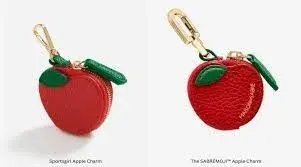
Maison de Sabre’s Claim: The brand has called fashion retailer Sportsgirl for the release of bag charms that were nearly identical to the brand’s signature Sabremoji Fruit Charms. These charms included shapes like, strawberry, orange, apple and were sold globally. While discussing the issue, the award-winning e-commerce expert Paul Waddy stated that, “But without proper design protection, they’re left wide open to being copied by larger players who can fast-track knockoffs without consequence.”
Status: No formal legal proceedings have been initiated. Sportsgirl subsequently removed the accused products from sale and stated they would review their internal processes.
- Rover v. Westside (2025)

Rover’s Claim: In an Instagram post, the Rover claimed that the retail brand Westside had ‘brazenly plagiarised’ their work and had copied the entire VISHWA collection and sold it for a much cheaper price. The earrings by the Rover are sold at a price of Rs.4,400, and the choker are sold at a price Rs.3,400, while Westside was selling the same earring for Rs.399 and choker necklace for Rs.299. While no lawsuit was filed, the Rover demanded immediate removal of the designs from the Westside stores and the website.
Westside’s Response: Website took the jewelry off their website.
Status: No legal proceedings initiated.
- TOKIKO v. Rhude Designs LLC

TOKIKO’s Claim: TOKIKO has marketed the design since May 2022 on posters and textiles also up for sale. It was at Paris fashion week in June 2023 that TOKIKO noticed its alleged infringing designs during the showcase of Rhude’s new STRADA collection made up of clothing such as shirts, shorts, and pants, with minor alterations to the original design. TOKIKO claimed that the infringing items of clothing bearing the near-replicated design were sold online and in physical stores in France.
Legal Actions taken thereafter: TOKIKO sent formal cease-and-desist letters to Rhude in July and August 2024, but Rhude failed to respond, and quietly removed the alleged infringing items from the website instead. However, TOKIKO asserts that Rhude re-uploaded the item on its website earlier in 2025, which constitutes willful and bad faith conduct. Therefore, TOKIKO has now claimed copyright infringement, unregistered community designs right infringement, parasitism (which in French law is equivalent to unfair competition) and free-riding on TOKIKO’s success.
Relief sought: TOKIKO is seeking from Rhude 1 million euros in damages, and independently the creator of the design, Anna Skoog is seeking €50,000 in compensation for violation of her moral rights. Together they also seek injunction that prohibits Rhude from further reproducing the design, destruction of the existing stock, and recall of all the products in circulation.
- Rahul Mishra v. Unknown Chinese Platforms (India)Indian designer Rahul Mishra secured dynamic injunctions against anonymous seller replicating his couture collections online. This judicial approach empowered courts to proactively block future infringing content across e-commerce and social media platforms.Rahul Mishra & Anr v John Doe & Anr (CS/COMM, 1194/2024, 24 December 2024)
- Stella McCartney v. Steve Madden (US)
McCartney’s legal action for the alleged copying of her Falabella tote ended in a settlement, illustrating how brand leverage and market stature play a significant role in enforcement success, even in IP protective jurisdictions like the United States.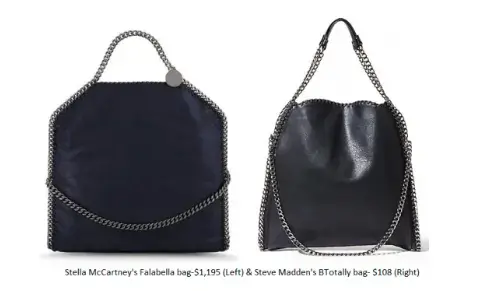
Final Thoughts
This whole thing with Anupamaa Dayal is not just one isolated incident. It shows how smaller designers, especially from countries like India, are often vulnerable. Even when they’re legally right, going up against a global brand is expensive and tiring. Moreover, the fashion industry’s unregulated borrowing culture often operates in a grey area between “inspiration” and “infringement.” Also, the legal system still does not fully protect fashion creators unless they take every step, register their works, watermark them, document everything. And even then, if someone in another country copies you, you have to be ready to fight in their courts, which can take years and cost a fortune.
Dayal’s case is still hanging in the air, there is no court outcome yet. But it’s a warning to all creatives: don’t just make beautiful work, protect it too. While Indian law supports unregistered copyright claims, international enforcement is often slow, expensive, and complex. Designers should proactively register their designs in primary markets, watermark digital content, and include NDAs when allowing foreign visitors to access their studios. Further, to create a level playing field, designers need institutional support, global treaties must be interpreted more inclusively, and enforcement mechanisms, both legal and technological must evolve with the pace of digital commerce.
The success of this matter, if pursued in courts, will set a useful precedent for small designers in cross-border creative disputes. Currently, the enforcement mechanism in India, and abroad constitutes the following remedies-
Remedies in India
- Civil Litigation: An infringement suit in India can be filed based on the dissemination of infringing material accessible within the territory, including via digital platforms.
- Interim Relief: Indian courts have increasingly granted dynamic injunctions, a powerful tool to block infringing content online across platforms.
- Border Control Measures: Rights can be registered with Indian Customs under IPR enforcement rules, enabling seizure of infringing imports.
International Enforcement
- Argentina Proceedings: Engagement of local counsel would be necessary for cease-and-desist actions, takedown notices, or copyright claims under domestic laws.
- WIPO ADR: The World Intellectual Property Organization offers arbitration and mediation services, although these are mostly contract-driven and less useful in direct infringement without prior agreement.
- Platform-Based Takedowns: The IP holder may file DMCA takedown notices with Instagram, Meta, or hosting services to restrict infringing content globally. In fact, in the case of Swami Ramdev v. Juggernaut Books and Ors. CM (M) (CS (OS) 27/2019), the Hon’ble Court had held that the content which was defamatory and uploaded from IP addresses within India had to be taken down, blocked and/or disabled for access on a global basis.
Recommendations
- Offer government-backed legal aid for IP enforcement by small or independent creators.
- Introduce fast-track fashion IP tribunals or mediation cells within IP offices.
- Promote industry-wide ethical standards for design attribution and licensing.