


By Lucy Rana and Huda Jafri
For more than a century, the name has been etched into multiple industries, carrying with it not just a product but a powerful association of identity and trust. Hence, when ITC discovered cigarettes being sold under the label “Gold Stag” in a packaging strikingly similar to the red-and-gold design of ITC Gold Flake packaging, it did not take long for the matter to land in the court. What followed was not just another trademark dispute, it was a test of how far the law will go in protecting a brand’s legacy, how much weight a single word like ‘Gold” can carry, and whether urgent intellectual property relief can bypass mandatory provision of mediation?
The Indian judiciary has steadily expanded the contours of trade dress protection over the last two decades, drawing from both statutory provisions under the Trademarks Act, 1999, as well as the common law principles.
The instant case of ITC Limited v. Pravin Kumar & Ors[1]., squarely fits within this evolving jurisprudence. ITC, one of India’s largest conglomerates, sought protection not merely for its word mark “GOLD FLAKE”, but more importantly for the distinctive trade dress and artistic features of its packaging. ITC alleged that its trade dress was dishonestly copied by the Respondents in marketing cigarettes under the mark “GOLD STAG”. The dispute presented two key questions before the Hon’ble Calcutta High Court:
- Whether ITC could assert exclusivity over the laudatory term “GOLD”?
- Whether the Respondent’s use of a substantially similar trade dress amounted to trademark infringement, copyright infringement and passing off?
Legacy and Rights of ITC
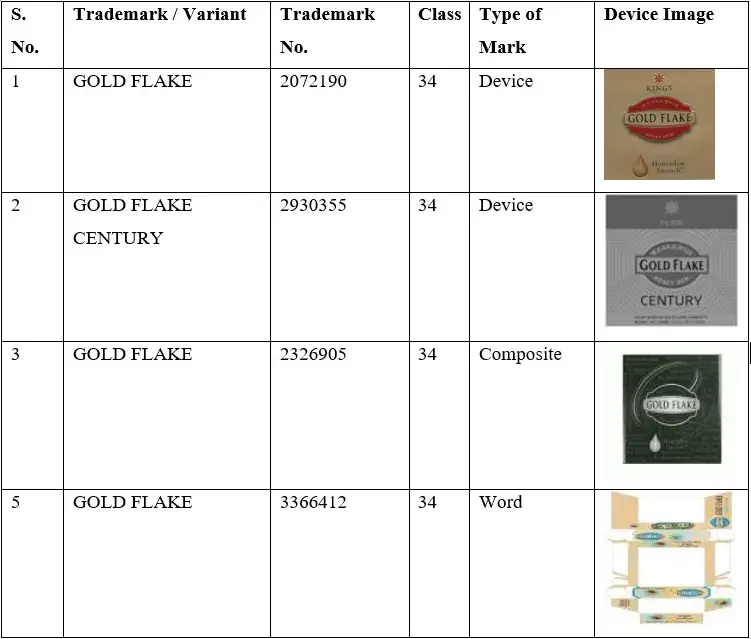
ITC Limited, is the registered proprietor of the well-known trademark “GOLD FLAKE” and its variants GOLD FLAKE Hallmark, Ultima, Century, and Super Star used continuously since 1905. ITC also owns multiple trademark and copyright registrations in respect of the packaging, device marks, layout, and colour combination forming the distinctive get-up of GOLD FLAKE cigarettes.
The following table lists registrations pertaining to ITC’s “GOLD FLAKE” trademarks:
The following table lists registrations pertaining to ITC’s “GOLD FLAKE” copyrights:
S. No. |
ROC No. |
Diary No. |
Work Title |
Type of Work |
Applicant Name |
1 |
A-99121/2013 | 13915/2012-CO/A | GOLD FLAKE KINGS RED | Artistic | ITC Limited |
2 |
A-99122/2013 | 13927/2012-CO/A | GOLD FLAKE KINGS GOLD | Artistic | ITC Limited |
3 |
A-119061/2017 | 14850/2016-CO/A | GOLD FLAKE FILTER TIPPED | Artistic | ITC Limited |
4 |
A-124191/2018 | 2534/2018-CO/A | GOLD FLAKE PREMIUM MD PACK 10HL | Artistic | ITC Limited |
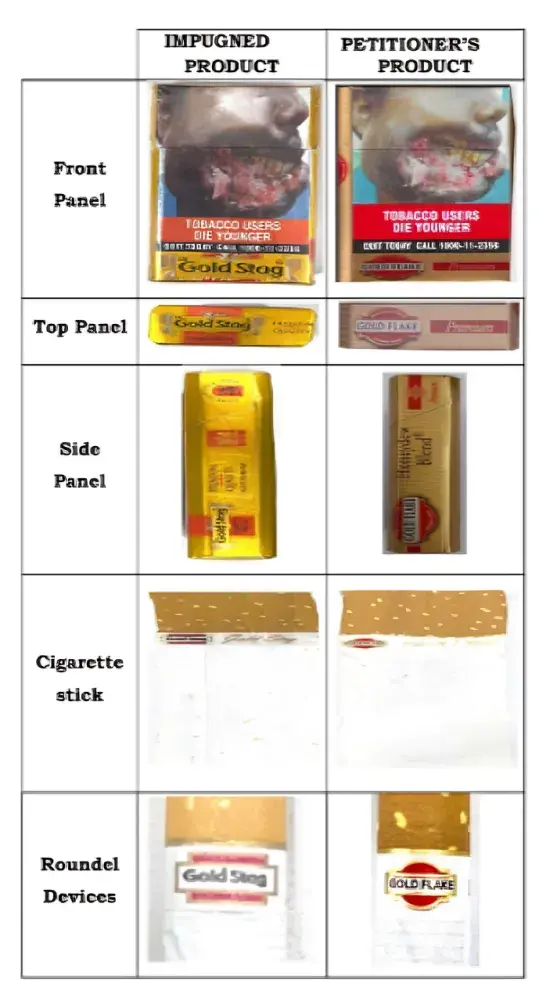
In December 2024, ITC discovered cigarettes being sold under the mark “GOLD STAG”, registered by one of the Respondents namely “IJM GOLD STAG.” The products bore a red-black-gold colour scheme, circular device, and placement of graphic elements that closely resembled ITC’s GOLD FLAKE packaging.
Allegations of Collusion and Counterfeiting
ITC alleged that the Respondents, operating through interconnected corporate entities, were engaged in counterfeiting and trafficking spurious cigarettes under the GOLD STAG mark to unfairly benefit from ITC’s reputation. The Plaintiff also contended that the near-identical packaging was deliberately designed to deceive consumers, create confusion, and dilute ITC’s long-standing goodwill.
Procedural History
ITC instituted a suit before the Intellectual Property Division of the Hon’ble Calcutta High Court (IP-COM/12/2025) on January 28, 2025, seeking ad-interim injunctions and ancillary reliefs.
The Court granted ad-interim injunctions in February 2025, restraining the Respondents from using the impugned mark and appointed Special Officers to inspect and report on the infringing goods.
Subsequently, the Respondents filed applications:
- Seeking vacation of the injunction under Order 39 Rule 3 CPC; and
- Challenging the exemption from pre-litigation mediation under Section 12A of the Commercial Courts Act, 2015.
Issues Before the Hon’ble Court
- Whether ITC could assert exclusive rights over the laudatory term “GOLD”, forming part of its registered mark “GOLD FLAKE”?
- Whether the Respondents’ use of “GOLD STAG” and its packaging constituted:
- trademark infringement under Sections 17 & 29 of the Trade Marks Act, 1999;
- passing off; and/or
- copyright infringement under Sections 14 and 51 of the Copyright Act, 1957.
- Whether the exemption from pre-litigation mediation under Section 12A of the Commercial Courts Act was justified?
- Whether the interim injunction and its service under Order 39 Rule 3 CPC were legally sustainable?
Hon’ble Court’s Analysis and Findings
- Pre-Litigation Mediation (Section 12A, Commercial Courts Act)The Court reaffirmed that intellectual property disputes involving ongoing or imminent infringement fall squarely within the “urgent interim relief” exception under Section 12A.ITC demonstrated that it had discovered the infringing packaging only in December 2024, and acted promptly to protect its rights. The Court found no mala fides in invoking urgency and upheld the dispensation of mediation.This reasoning aligns with the principle that time-sensitive IP enforcement actions cannot be delayed by mandatory pre-filing mediation, especially where infringement is continuing or imminent.
- Exclusivity over the Word “GOLD”The Court reiterated that registration of a composite mark does not confer exclusive rights over descriptive or laudatory elements within that mark, as per Section 17(2)(b) of the Trade Marks Act, 1999.While acknowledging ITC’s long-standing use of “GOLD FLAKE”, the Court observed:· The word “GOLD” is laudatory and descriptive, commonly used in the tobacco and liquor industries to denote superior quality.
· ITC does not own registration over the word “GOLD” simpliciter, and several third-party registrations contain “GOLD.”
Accordingly, ITC could not monopolise the word “GOLD” itself but retained protection over its composite mark and trade dress as a whole.
- Trade Dress and Packaging SimilarityUpon visual comparison, the Court found a “striking resemblance” between GOLD FLAKE and GOLD STAG packaging, particularly in:· the red and black colour palette,· golden roundel and device placement, and
· overall layout and typography.
Although ITC could not monopolise “GOLD” per se, the cumulative visual impression of the GOLD STAG packaging was held to imitate ITC’s distinctive trade dress. The Court emphasised that trade dress protection operates independently of word-mark exclusivity, protecting overall get-up, appearance, and consumer perception from imitation.
- Copyright InfringementWith respect to copyright infringement, ITC (Respondents in appeal) claimed prior publication of their artwork in 2013. However, the Court found this assertion unreliable, as the packaging included statutory health warnings that became mandatory only in 2016, thereby contradicting the claimed timeline.The Respondents further contended that the copyright licence relied upon by ITC did not comply with Sections 19 and 30A of the Copyright Act, thereby disputing ITC’s copyright ownership.The Court, therefore, held that ITC had made out a prima facie case of copyright infringement in addition to its trademark and passing-off claims.
- Balance of Convenience and Irreparable HarmApplying the principles laid down in American Cyanamid Co. v. Ethicon Ltd.[2], the Court found that:· ITC had established a strong prima facie case, supported by its longstanding goodwill and registrations.· There was a clear risk of consumer confusion and dilution if the Defendants continued using the impugned packaging.
· The Defendants’ conduct appeared dishonest and collusive, warranting continuation of injunctive relief.
The Court also dismissed technical objections under Order 39 Rule 3 CPC, holding that procedural irregularities could not override the need to protect valuable intellectual property rights.
Order
At the interim stage of the proceedings, the Hon’ble Calcutta High Court declined to interfere with the ad-interim injunction earlier granted in favour of ITC Limited. The Court confirmed the continuation of the injunction, restraining the Respondents, their agents, and all persons acting on their behalf from manufacturing, selling, offering for sale, or otherwise dealing in cigarettes under the mark “GOLD STAG” or under any packaging, trade dress, or get-up that is deceptively similar to ITC’s “GOLD FLAKE” packaging.
The Court further dismissed the respondents’ applications seeking (i) vacation of the ad-interim injunction under Order XXXIX Rule 3 of the Code of Civil Procedure, 1908, and (ii) revocation of the exemption granted to ITC from pre-litigation mediation under Section 12A of the Commercial Courts Act, 2015.
In order to ensure effective enforcement of its directions and to prevent continued circulation of infringing goods, the Court directed the Special Officers, already appointed to continue conducting periodic inspection of the Respondents’ premises and distribution channels, and to submit status reports to the Court from time to time. These directions were ordered to remain in force until final adjudication of the suit.
Conclusion
The Hon’ble Calcutta High Court’s decision in ITC Ltd. v. Pravin Kumar & Ors., reflects the modern trademark dilemma between protecting legacy and preserving competition. It observed that “laudatory or descriptive terms such as ‘Gold’ cannot be monopolised without compelling evidence of distinctiveness.” However, it simultaneously recognised that ITC’s long-standing goodwill in its Gold Flake brand could not be ignored where the rival’s packaging was found deceptively similar.
In essence, the judgment reinforces that while common words must remain in the public domain, a trader’s distinctive trade dress and reputation built over decades continue to merit robust judicial protection.
[1] IP-COM/12/2025
[2] American Cyanamid Co. v. Ethicon Ltd. [1975] AC 396, [1975] 1 All ER 504 (HL)