


By Lucy Rana and Huda Jafri
Introduction
India’s intellectual property landscape is witnessing an unprecedented surge, as highlighted in the IP India Annual Report 2024–2025[1], published by the Office of the Controller General of Patents, Designs and Trade Marks (CGPDTM). During the financial year 2024–25, overall IP filings rose to 7,49,946, representing a year-on-year increase of nearly 20% over the previous year, underscoring the nation’s deepening culture of innovation and creativity.
During the same financial year, pDesign filings jumped by more than 40%, highlighting the growing emphasis on industrial and aesthetic innovation, while trademark applications exceeded 5.5 lakh, reflecting the rapid pace of brand creation and commercial growth across sectors. Even Geographical Indications and Copyright filings recorded notable gains, reinforcing India’s commitment to protecting traditional knowledge and creative works.
This remarkable growth has been driven by technology-enabled reforms, streamlined processes, and expanded manpower. Initiatives such as the AI-powered Trade Mark Search, the IP Saarthi chatbot, and the National Intellectual Property Awareness Mission (NIPAM) have enhanced accessibility, improved examination efficiency, and expanded IP awareness nationwide.
With the onboarding of 407 new patent examiners and 200 additional trademark posts, along with revenues crossing ₹1,449 crore, India is well-positioned to further strengthen its IP administration. The CGPDTM’s achievements in the IP India Annual Report 2024–2025 reflect a dynamic, future-ready IP ecosystem that is driving innovation, safeguarding creativity, and positioning India as a global leader in intellectual property.
Trends in Last Five Years with respect to filing of IP applications (2020-25)
| Applications | 2020-21 | 2021-22 | 2022-23 | 2023-24 | 2024-25 |
| Patent | 58503 | 66440 | 82811 | 92168 | 110375 |
| Design | 14241 | 22699 | 22698 | 30389 | 43005 |
| Trade Mark | 431213 | 447805 | 466580 | 476089 | 552190 |
| GI | 58 | 116 | 211 | 134 | 275 |
PATENTS
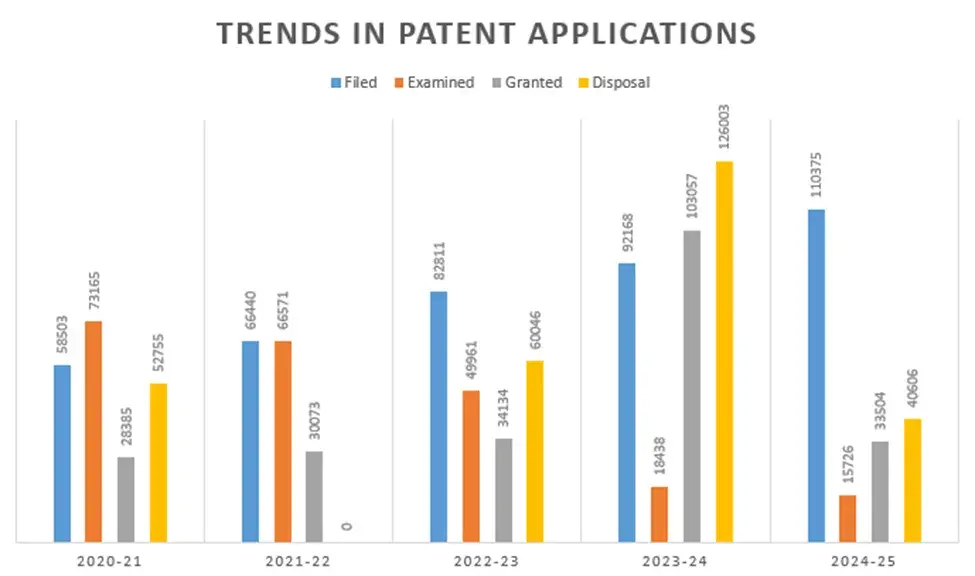
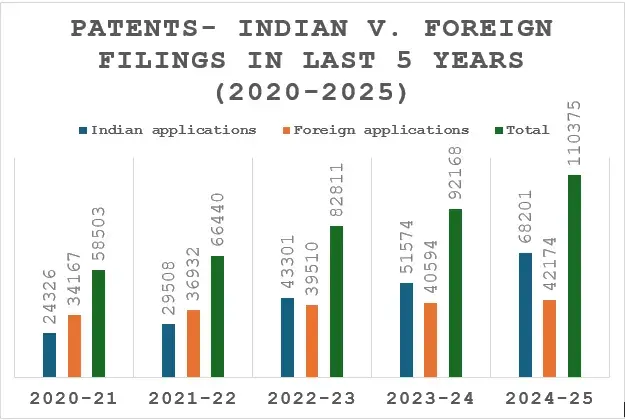
The patent sector in India sustained its robust expansion in 2024–25, reflecting the country’s growing research and development activities. A total of 110,375 patent applications were filed during the year, marking an increase of nearly 19.75% compared to the previous year. Domestic filings showed particularly strong growth, rising to 68,201 applications, now accounting for 61.79% of total filings, up from 51,574 (55.96%) in 2023–24.
Trends in Patent Applications
| Year | 2020-21 | 2021-22 | 2022-23 | 2023-24 | 2024-25 |
| Filed | 58503 | 66440 | 82811 | 92168 | 110375 |
| Examined | 73165 | 66571 | 49961 | 18438 | 15726 |
| Granted | 28385 | 30073 | 34134 | 103057 | 33504 |
| Disposal | 52755 | 35990* | 60046 | 126003 | 40606 |
Patent filing Trends: Indian applicants v. Foreign applicants
The Patent filing trends in the recent years also marks a significant leap when it comes to a surge seen in patent filings by Indian applicants as compared to foreign applicants. The graph below indicates how patent filings by Indian nationals have shown a consistent surge in the last 3 years.
Foreign Patent filing in India
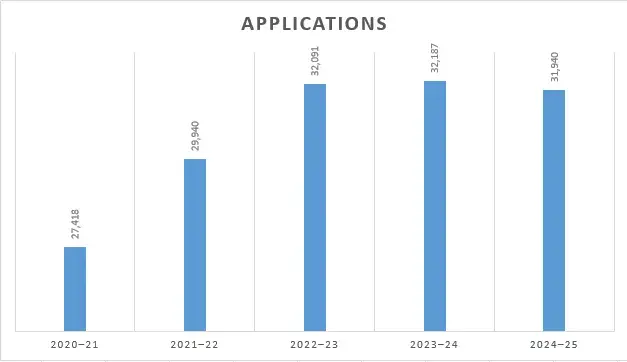
Majority of foreign patent applications were filed through the PCT National Phase route. A total of 31,940 such applications were received, reflecting a marginal decrease of approximately 0.76% compared to the previous year’s figure of 32,187. Among all foreign applicants, the United States of America emerged as the leading filing country, accounting for 10,620 applications.
Trend of PCT Filing Over the Last 5 years
| Financial Year | Applications |
| 2020–21 | 27,418 |
| 2021–22 | 29,940 |
| 2022–23 | 32,091 |
| 2023–24 | 32,187 |
| 2024–25 | 31,940 |
DESIGN
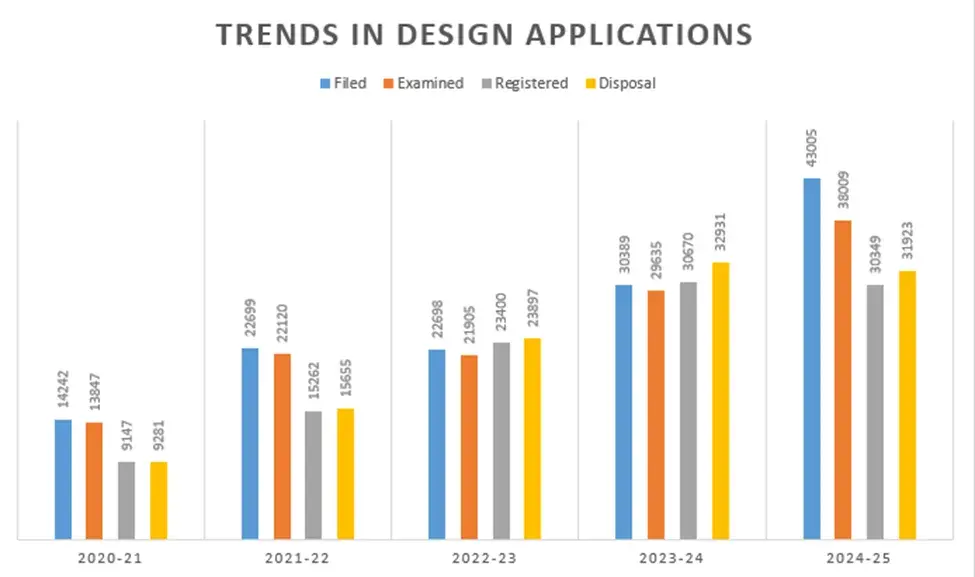
The design sector in India witnessed substantial growth during 2024–25, reflecting the rising importance of both aesthetic and functional protection for industrial products. A total of 43,005 design applications were filed this year, marking a remarkable 41.52% increase compared to the previous year.
Examination activity remained strong, with 38,009 applications examined, while 30,349 designs were registered and 31,923 applications disposed of, including granted, refused, abandoned, or withdrawn cases, demonstrating a consistent performance in line with the previous year.
Trends in Design Applications
| Year | 2020-21 | 2021-22 | 2022-23 | 2023-24 | 2024-25 |
| Filed | 14242 | 22699 | 22698 | 30389 | 43005 |
| Examined | 13847 | 22120 | 21905 | 29635 | 38009 |
| Registered | 9147 | 15262 | 23400 | 30670 | 30349 |
| Disposal | 9281 | 15655 | 23897 | 32931 | 31923 |
TRADE MARKS
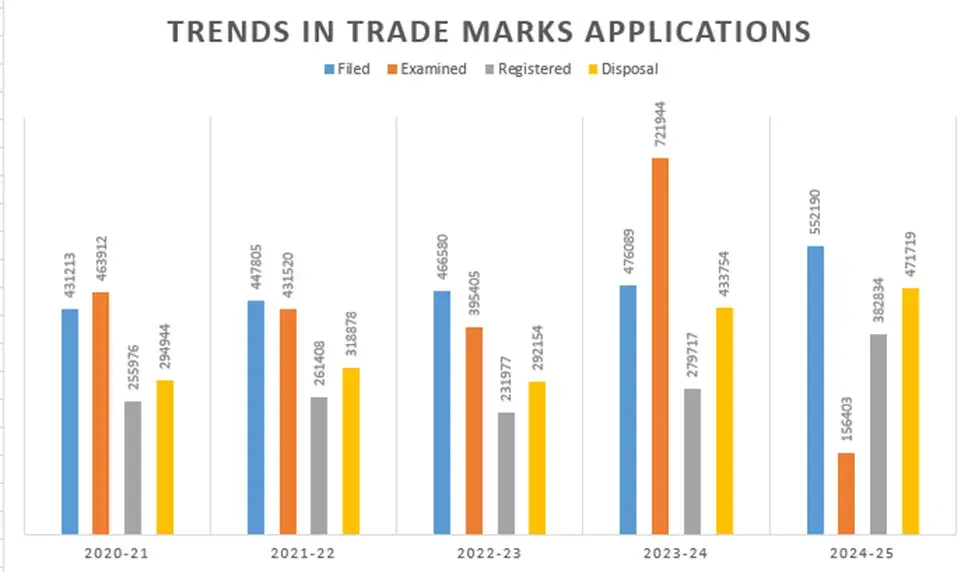
Trademarks continue to be widely filed in India, highlighting the country’s dynamic commercial environment. In 2024–25, a total of 552,190 applications for trademark registration were submitted, with 156,403 applications examined during the year.
The number of trademark registrations and disposals increased significantly, by 36.86% and 8.75% respectively, compared to the previous year.
Trends in Trade Marks Applications
| Year | 2020-21 | 2021-22 | 2022-23 | 2023-24 | 2024-25 |
| Filed | 431213 | 447805 | 466580 | 476089 | 552190 |
| Examined | 463912 | 431520 | 395405 | 721944 | 156403 |
| Registered | 255976 | 261408 | 231977 | 279717 | 382834 |
| Disposal | 294944 | 318878 | 292154 | 433754 | 471719 |
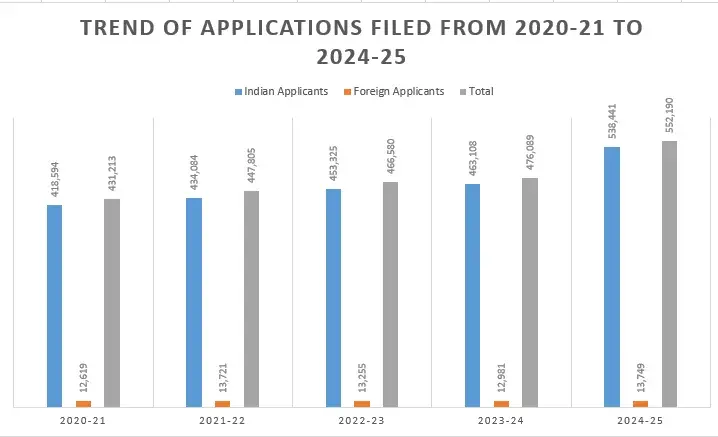
Trend of Applications Filed by Indian Applicants and Foreign Applicants 2020-21 to 2024-25
| Year | Indian Applicants | Foreign Applicants | Total |
| 2020-21 | 418,594 | 12,619 | 431,213 |
| 2021-22 | 434,084 | 13,721 | 447,805 |
| 2022-23 | 453,325 | 13,255 | 466,580 |
| 2023-24 | 463,108 | 12,981 | 476,089 |
| 2024-25 | 538,441 | 13,749 | 552,190 |
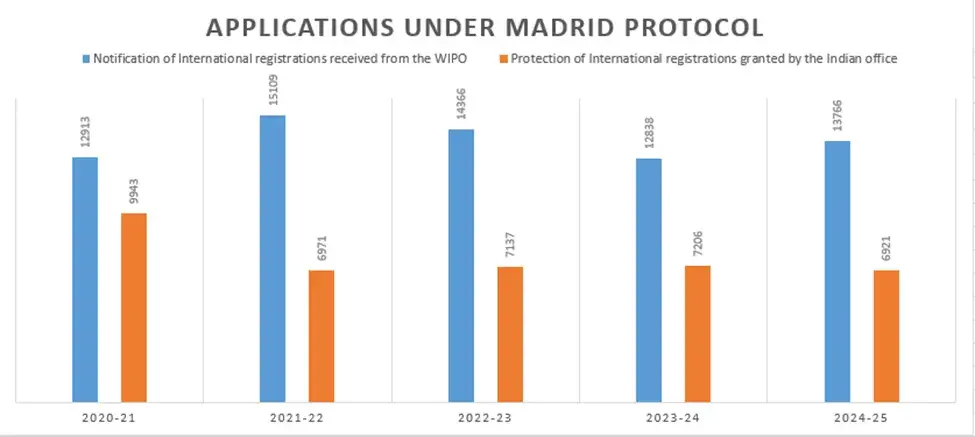
Applications under the Madrid Protocol
During 2024–25, applications under the Madrid Protocol demonstrated sustained international engagement with the Indian trademark system. The World Intellectual Property Organization (WIPO) notified the Indian Office of 13,766 international registrations seeking protection in India. Mirror records in the form of International Registrations Designated to India (IRDI) were created for all such applications, of which 13,730 IRDIs were examined. Based on examination, 3,579 provisional refusals were communicated to WIPO, while a further 994 provisional refusals arose from third-party oppositions published in the Trade Marks Journal. During the year, 575 oppositions were finally disposed of. After completion of all procedures under the Trade Marks Act, 6,921 international registrations were granted protection and notified to WIPO, including 2,796 cases in which applicants were not required to approach the Indian Office. Conversely, protection was refused in 3,145 international registrations.
Trends of International Trademarks Registration Notified by WIPO during last 5 years
| Year | Notification of International registrations received from the WIPO | Protection of International registrations granted by the Indian office |
| 2020-21 | 12913 | 9943 |
| 2021-22 | 15109 | 6971 |
| 2022-23 | 14366 | 7137 |
| 2023-24 | 12838 | 7206 |
| 2024-25 | 13766 | 6921 |
Details of Opposition Applications Filed at Various Offices
| TM Office | Opposition/Rectification filed | Cases disposed |
| Ahmedabad | 8428 | 3885 |
| Chennai | 13000 | 8435 |
| Delhi | 37452 | 26350 |
| Kolkata | 4116 | 3744 |
| Mumbai | 18720 | 9676 |
| IR Division | 1199 | 575 |

GEOGRAPHICAL INDICATIONS
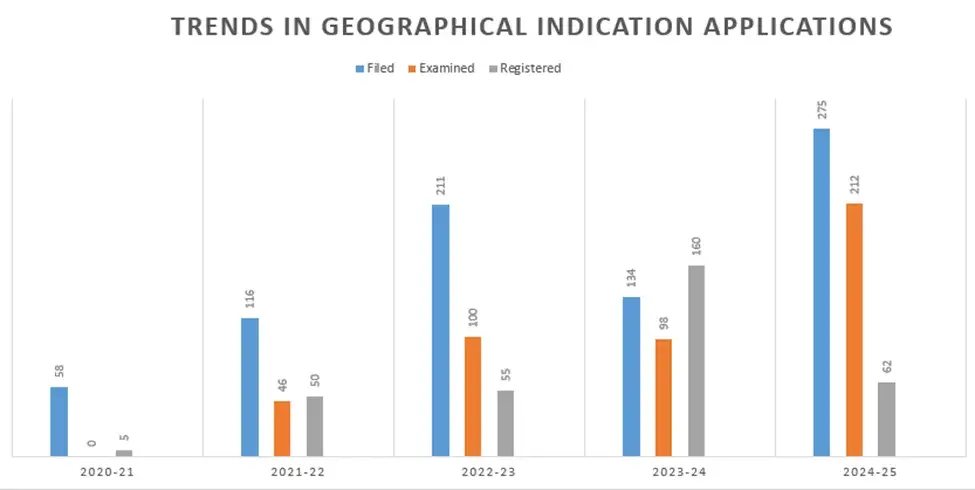
Geographical Indications (GIs) in India are progressing steadily, playing a vital role in safeguarding the unique identity of regional products. During 2024–25, a total of 275 applications were filed, with 212 applications examined and 62 GIs registered.
Trends in Geographical Indication Applications
| Year | 2020-21 | 2021-22 | 2022-23 | 2023-24 | 2024-25 |
| Filed | 58 | 116 | 211 | 134 | 275 |
| Examined | 0 | 46 | 100 | 98 | 212 |
| Registered | 5 | 50 | 55 | 160 | 62 |
COPYRIGHTS:
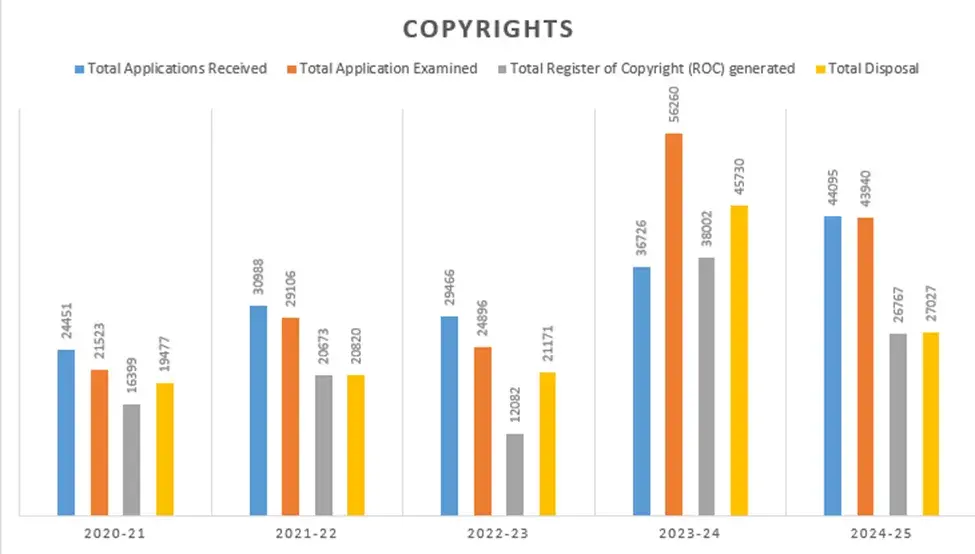
Copyright filings in India continued to rise in 2024–25, reflecting the increasing recognition and value of creative works in the economy. A total of 44,095 applications for copyright registration were received during the year, with 43,940 applications examined.
Out of these, 26,767 copyrights were registered, and a total of 27,027 applications were disposed of, including granted, refused, abandoned, or withdrawn cases.
Trends in Copyright Application
| Year | Total Applications Received | Total Application Examined | Total Register of Copyright (ROC) generated | Total Disposal |
| 2020-21 | 24451 | 21523 | 16399 | 19477 |
| 2021-22 | 30988 | 29106 | 20673 | 20820 |
| 2022-23 | 29466 | 24896 | 12082 | 21171 |
| 2023-24 | 36726 | 56260 | 38002 | 45730 |
| 2024-25 | 44095 | 43940 | 26767 | 27027 |
Strengthening India’s Intellectual Property Ecosystem: Highlights from the IP India Annual Report 2024-25
The Office of the Controller General of Patents, Designs, and Trade Marks (CGPDTM) has undertaken significant initiatives to bolster India’s Intellectual Property Rights (IPR) ecosystem. These efforts focus on legislative reforms, digitization, transparency, stakeholder convenience, and awareness building, reflecting the government’s commitment to a modern, efficient, and citizen-centric IP administration.
Patents
The Patents Rules, 2003 have undergone multiple amendments in 2016, 2019, 2020, 2021, and most recently in 2024 to simplify patent procedures, reduce examination timelines, and promote digital transformation. Key highlights from the year include:
- Implementation of 2024 amendments: Transformative provisions such as the introduction of the Certificate of Inventorship were operationalized, with around 850 certificates issued.
- Enhanced online processes: Pre-grant oppositions now must be filed online, Form-31 has been introduced for availing the grace period, and most procedural changes have been successfully implemented digitally.
- Strengthening examination capacity: Recruitment of 550 new Examiners of Patents and Designs was completed, with 407 joining induction training at RGNIIPM, Nagpur, and Dr. MCR HRD Institute, Hyderabad.
These measures have streamlined patent administration and encouraged innovation across critical sectors.
Trade Marks
The Trade Marks Registry has embraced several technology-driven initiatives to improve transparency, operational efficiency, and stakeholder convenience:
- IT modernization: Cloud migration, AI/ML-powered trademark search, dynamic hearing boards, automated reminders, and API integration have significantly enhanced office functioning.
- Human resource strengthening: 200 additional posts were sanctioned to ensure timely and high-quality services.
- Copyright registration improvements: The process has become more secure, transparent, and efficient.
Further, the Office introduced a publicly accessible IP Dashboard providing real-time data on patents, designs, trademarks, copyrights, and geographical indications. AI-powered trademark search and the IP Sarthi Chatbot now provide stakeholders with faster, more accurate guidance. Additionally, the “WIPO IP Diagnostics – Indian Adaptation” tool enables small businesses to assess their IP assets and generate customized reports in multiple Indian languages.
Modernization and Ease of Filing
A series of initiatives have streamlined filing, improved transparency, and strengthened accountability:
- Dynamic hearing boards and automation of notices enhance efficiency.
- Integration with platforms like GeM and military systems ensures smoother verification.
- Continuous IT upgrades support paperless processes and digital service delivery.
IP Awareness
The National Intellectual Property Awareness Mission (NIPAM), launched during Azadi Ka Amrit Mahotsav, continues to sensitize students, faculty, MSMEs, and startups about IPR. Over 98,500 individuals from all states and union territories have been reached. RGNIIPM also conducts specialized and basic IP training programs in collaboration with universities and WIPO.
Jansunvai & Feedback Mechanism
CGPDTM has strengthened grievance redressal through:
- Daily Open House Conferences (Jan Sunwai): Direct interaction with senior officials.
- Open House IT Helpdesk: A single-window platform for IP queries and complaints, achieving over 95% disposal of grievances.
Conclusion
The IP India Annual Report 2024–25 reflects a landmark year for the nation’s intellectual property ecosystem, marked by historic growth in filings, enhanced technological integration, and strengthened institutional capacity. Through sustained reforms, digitization, and stakeholder-centric initiatives, CGPDTM has not only streamlined IP administration but also expanded access, awareness, and protection of intellectual property across India.
From the surge in patent and design applications to the widespread adoption of AI-driven tools for trademarks and the proactive outreach under the National Intellectual Property Awareness Mission, the year underscores India’s commitment to fostering innovation, creativity, and entrepreneurship. With strengthened grievance redressal mechanisms, international cooperation, and a focus on transparency and efficiency, India is poised to continue building a robust, future-ready IP ecosystem that empowers innovators, safeguards creative works, and positions the country as a global leader in intellectual property.
[1] https://ipindia.gov.in/writereaddata/Portal/Images/pdf/English_Annual_Report_2024-25.pdf