


By Shilpi Saurav Sharan and Pallavi Paul
The Hon’ble Delhi High Court’s recent order in the case of Colgate Palmolive Co. v. John Doe & Ors.[1], serves as an important precedent for trade dress protection and border enforcement in intellectual property disputes, particularly emphasizing the overall visual impression of packaging and the responsibilities of brand owners in operational enforcement.
Background and Procedural Order
The Plaintiff, Colgate alleged that impugned ‘Doctor Good’ toothbrushes imported via Mundra Port were packed in a red-blue trade dress that was deceptively similar to Colgate’s well‑known red‑white and red‑blue packaging for its oral care products.
The Plaintiff content that the impugned consignment of around 2,40,000, toothbrushes was shipped from China[2], and was physically lying at Mundra Port, reportedly intended for onward shipment to Africa.
Colgate claimed longstanding use and goodwill in its Colgate formative marks and distinctive packaging, and sought reliefs for trade mark infringement, copyright infringement, passing off and related reliefs, along with urgent interim orders to intercept the suspected infringing goods at the port.
At the threshold, the Court granted several procedural relaxations to facilitate urgent relief for Colgate. In light of the need for immediate interim measures, it exempted Colgate from the pre‑institution mediation requirement under Section 12A of the Commercial Courts Act, aligning with the Supreme Court’s ruling in Yamini Manohar v. T.K.D. Krithi[3].
The Court also granted (i) time to file court fees[4], (ii) exemption from serving prior notice[5] on the Customs authorities (Mundra Custom House and CBIC), and (iii) exemption from advance service on the importer and exporter, accepting Colgate’s submission that prior notice could enable suppression or concealment of infringing activities and digital footprints.
The plaint was directed to be registered as a commercial suit, and summons were issued with standard timelines for filing written statements, replications, and for admission and denial of documents.
Key legal Issues
- Trade-Dress Protection
Colgate emphasised that its oral and dental care products, especially toothpastes and toothbrushes have been long associated with its distinctive red‑white and red‑blue trade dress. It claimed that this color combination along with the characteristic layout and branding, functions as an indicator of origin, and is supported by decades of substantive sales and advertising in India.Colgate produced side‑by‑side depictions of its toothbrush packaging and the impugned ‘Doctor Good’ packaging, and the order itself reproduces a comparison chart setting out the similarities which includes identical red-blue split with red on the left, blue on the right, similar placement of brand name on the coloured band and on the handle, similar placement of product variant descriptors, and an overall identical white‑red‑blue palette and visual impression.Comparative photographs as depicted in the order is pasted below for reference: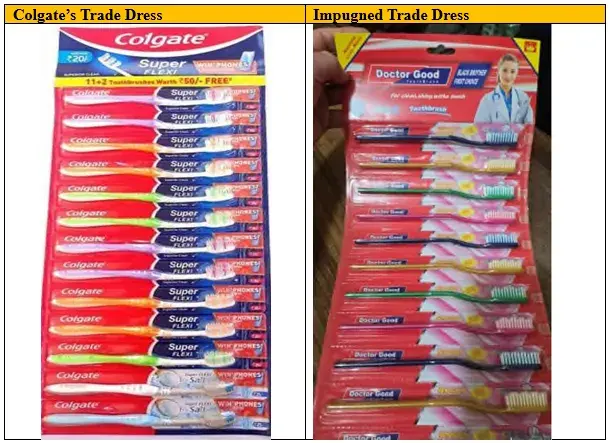
The Court accepted that Colgate has built up significant goodwill and reputation in its trade dress, recognised by both the trade and the public. It held, prima facie, that the impugned trade dress is deceptively similar and its adoption is likely to dilute Colgate’s goodwill and reputation. Given the identical product category, trade channels, and consumer base, the balance of convenience was found to lie in favour of Colgate and against the importer and exporter.
- Border Enforcement and Goods in Transit
A key dimension of the case is that the impugned toothbrushes were allegedly destined for Africa, and not for sale in India. Colgate therefore made a deliberate doctrinal move, contending that the goods, would still qualify as ‘imports’ under Section 29(6)(c) of the Trade Marks Act, 1999 and Section 51(b)(iv) of the Copyright Act, 1957, because they had physically entered Indian territory and were under Customs control at Mundra Port.Colgate relied on information from the CBIC’s ICEGATE portal to show that the container carrying the infringing goods had arrived at Mundra and remained there. It also referred to Chapter 16 of the Customs Manual, 2025, which governs the detention and storage of imported or export goods in bonded warehouses and the accrual of warehousing and demurrage charges, and to Chapter 11, which permits Customs to reseal containers with Customs seals after inspection.Colgate also relied on Rule 5(a) and (b) of the Imported Goods Enforcement Rules, 2007 (IPRE Rules), which require rights-holders to (i) undertake to protect importers or owners from liability upon wrongful suspension and to bear destruction and demurrage costs, and (ii) execute an indemnity bond indemnifying Customs against liabilities and expenses arising from such suspension. Colgate undertook to pay all applicable warehousing, demurrage and resealing charges, and to furnish the required undertakings and indemnity bonds.
Interim Remedy
Despite the strong prima facie finding of deceptive similarity and potential dilution, the Court denied at this stage to grant a full interim injunction restraining the importer or exporter from using the impugned trade dress. The Court reasoned that an injunction requires a firm factual finding that the specific boxes indeed contain infringing goods, which could not be presumed until the goods were actually inspected.
The Court directed Customs, if the container was at the Mundra Port, to open it, identify and seize the boxes, and inspect them in the presence of two Colgate representatives to determine whether the goods bear the impugned trade dress or any other trade dress deceptively similar to Colgate’s. Additionally, the Court directed Customs to detain the containers in a bonded warehouse until further orders.
The matter is now listed for hearing on January 13, 2026.
Conclusion
Although interlocutory, the order is significant as it underscores the Court’s willingness to protect trade dress in colour combinations and packaging, assessed by overall visual impression, particularly in the FMCG sector. It also highlights the importance of companies being prepared to bear operational costs of seizure, to persuade courts to authorise intrusive port-side measures.
The case advances the debate on applicability of Indian IP law to goods ‘in transit’. While the Court did not definitively interpret ‘import’, it held that the physical presence of goods at an Indian port provides a sufficient nexus to justify the interim seizure and inspection. This order signals a practical shift towards treating ports as active IP enforcement sites rather than mere transit points.
[1] CS(COMM) 988/2025
[2] Container No. IAAU1891912, with boxes marked ASB026 and ASB027
[3] 2023 SCC OnLine SC 1382;
In this case, the scope and ambit of the words ‘contemplate any urgent interim relief’ were considered, and it was held that, the plaint, documents, and facts should show and indicate the need for urgent interim relief.
[4] Section 149 read with Section 151 of the Code of Civil Procedure, 1908 (“CPC”)
[5] Section 80 read with Section 151 of the Code of Civil Procedure, 1908 (“CPC”)