








Labour Laws in India
India ranks second globally in terms of labour population and is widely regarded as one of the most cost-efficient and productive workforces in the world. The combined public and private sectors employ over 600 million workers, and the labour market contributes more than 40 percent of India’s GDP. Manufacturing and services, powered by India’s vast human capital, form the backbone of the national economy and are expected to witness rapid transformation in the coming years.
Given the scale, diversity and economic importance of India’s workforce, the need for a robust and contemporary labour law framework has always been critical. Labour legislation not only governs employer-employee relationships but also ensures industrial harmony, protects worker rights and supports sustainable economic growth.
Evolution of the Labour Law Framework in India
The Second National Commission on Labour (2002) recognised these structural limitations and recommended consolidation of labour laws into four broad categories:
- Wages
- Social Security
- Industrial Relations
- Occupational Safety, Health and Working Conditions
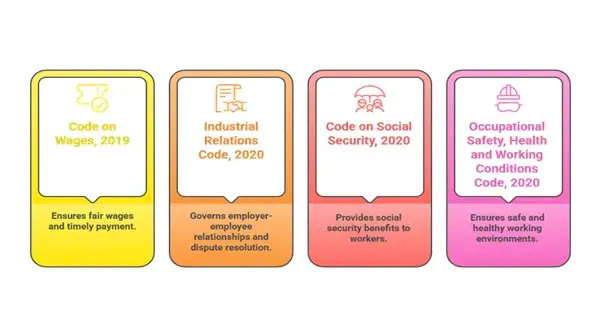
Acting on these recommendations, the Ministry of Labour & Employment introduced four comprehensive Labour Codes between 2019 and 2020, subsuming 29 existing central labour laws into a unified legislative framework.
Constitutional Foundations of Labour Law
Labour law in India is firmly grounded in constitutional principles. The Constitution of India guarantees equality, dignity and livelihood to workers. In Olga Tellis v. Bombay Municipal Corporation, the Supreme Court held that the right to livelihood is an integral part of the right to life under Article 21.
Further, Articles 14, 15, 16, 19 and 23, read with the Directive Principles of State Policy, provide safeguards against discrimination, forced labour and unsafe working conditions. These constitutional protections continue to inform the interpretation and enforcement of labour legislation, including the new Labour Codes.
India’s New Labour Codes: A Unified Regulatory Framework
India has entered a new phase of employment regulation with the introduction of the four Labour Codes. Together, these Codes replace 29 central labour laws with a consolidated framework governing wages, industrial relations, social security and working conditions. The objective is to bring clarity, consistency and predictability to employment regulation while expanding social security coverage and easing compliance.
I. Code on Wages, 2019
The Code on Wages consolidates four earlier laws dealing with minimum wages, payment of wages, bonus and equal remuneration. It establishes a uniform wage framework applicable across sectors.
Key Features
- Universal applicability of minimum wages across all employments
- Introduction of a national floor wage, above which states must fix minimum wages
- A standard definition of wages to reduce disputes and ensure uniformity in computation of provident fund, ESIC, gratuity and bonus
- Mandatory equal remuneration for similar work without gender-based discrimination
- Prescribed timelines for payment of monthly, weekly and daily wages
- Standardised rules governing deductions and overtime payments
II. Industrial Relations Code, 2020
The Industrial Relations Code governs trade unions, standing orders and industrial disputes, aiming to balance worker protection with operational flexibility for employers.
Key Features
- Framework for recognition of negotiating unions or councils for collective bargaining
- Standing orders made mandatory for establishments employing 300 or more workers, increased from the earlier threshold of 100 workers
- Formal recognition of fixed-term employment with entitlement to statutory benefits on a proportionate basis, including gratuity
- Prior government approval for retrenchment, layoff and closure applicable to establishments employing 300 or more workers
- Streamlined dispute resolution through rationalised conciliation and tribunal mechanisms
III. Code on Social Security, 2020
The Code on Social Security consolidates nine social security laws and significantly expands the scope of coverage.
Key Features
- Extension of social security benefits to organised, unorganised, gig and platform workers
- Mandatory contributions by aggregator platforms towards social security schemes for gig and platform workers
- Continuation of provident fund and ESIC schemes with wider coverage and nationwide applicability of ESIC
- Mandatory ESIC coverage for hazardous activities, even where only one employee is engaged
- Uniform gratuity eligibility after one year of service for establishments governed by Shops and Establishments Acts and factories, with pro rata gratuity for fixed-term employees
- Continuation of maternity benefit provisions and creche obligations
- Requirement for digital maintenance of registers and records
IV. Occupational Safety, Health and Working Conditions Code, 2020
This Code consolidates 13 laws regulating workplace safety, health standards, licensing and working hours across sectors.
Key Features
- Single registration replacing multiple earlier registrations
- Uniform health and safety standards covering cleanliness, ventilation, emergency procedures and medical facilities
- Mandatory annual health check-ups for workers above 40 years of age
- Mandatory issuance of formal appointment letters to all workers
- Permitting employment of women in all roles, including night shifts, subject to consent and prescribed safety measures
- Introduction of the Inspector-cum-Facilitator model to encourage compliance through guidance rather than inspection-centric enforcement
- Provision for a common licence covering factories, industrial premises and contract labour
Implementation Reality and Employer Readiness
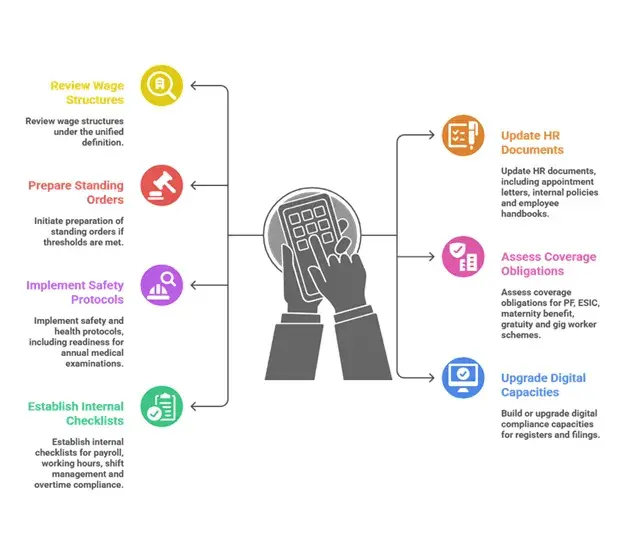
While the Labour Codes aim to simplify compliance, their implementation presents practical challenges. The transition requires employers to realign internal policies, employment contracts, wage structures and compliance systems. Further, since labour is a concurrent subject, state-specific rules will play a critical role in determining actual compliance obligations.
Employers must prioritise workforce audits, review wage structures in light of the new wage definition, update standing orders and appointment letters, and prepare for increased digital compliance.
The new Labour Codes represent a significant modernisation of India’s employment law framework. They bring consistency, transparency and broader social protection while offering businesses a more streamlined statutory structure. However, the success of this transition will depend on effective implementation, regulatory clarity and pragmatic enforcement.
For employers, particularly MSMEs and service sector entities, early preparedness and proactive compliance will be key. The coming years will determine how seamlessly India’s labour law reforms translate into improved ease of doing business while safeguarding worker rights and dignity.