

By Lucy Rana and Abhishek Chandok
From 4,233 filings in 1995 to a record 13,436 in 2025, a data-driven analysis of Sri Lanka’s trademark landscape and what the numbers say about the road ahead.
| 13,436 Applications 2025 |
+8.5% YoY Growth (2024→25) |
4,844 Registrations 2025 |
30 yrs of NIPO Data |
Overview: A Market That Has Quietly Tripled
The National Intellectual Property Office of Sri Lanka (NIPO) has been recording trademark filings since 1995. Over those three decades, the volume of applications has grown nearly threefold, from 4,233 in 1995 to 12,379 in 2024, with 2025 pushing the all-time record to 13,436. The story, however, is not one of smooth linear growth. It is punctuated by economic shocks, global disruptions, and a remarkable post-crisis resurgence that signals a maturing IP ecosystem.
Sri Lanka’s trademark filings have grown +217% from 1995 to 2025, a compounded annual growth rate of roughly 3.8% over thirty years, accelerating sharply in the 2020s despite the worst economic crisis in the country’s history.
Total Trademark Applications: 1995 – 2025
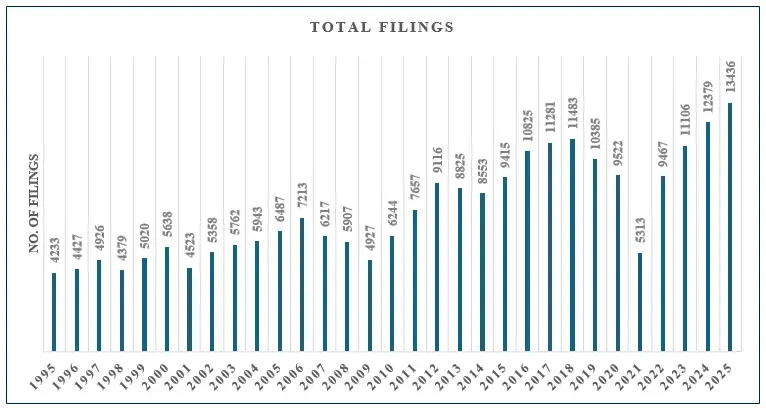
| 4,233 Baseline Total Filings — 1995 |
12,379 ↑ 217% vs 1995 Total Filings — 2024 |
13,436 ↑ All-time Record Total Filings — 2025 |
Historical Phases: Five Phases That Define the Journey
The 30-year data is not a single trend, it is five distinct chapters, each shaped by a different economic and regulatory reality.
| 1995–2001 | Steady Climb: The Pre-Digital Decade
Applications rose from 4,233 to 4,523, a modest 7% over six years. Resident filings dominated; international interest was limited. The market was largely domestic. |
| 2002–2010 | The Growth Surge: Post-War Confidence
As the civil conflict wound down, filings climbed from 5,358 in 2002 to 6,244 in 2010. International applications grew strongly, doubling from 1,613 to 2,302. Sri Lanka began attracting global brand attention. |
| 2011–2016 | Acceleration: The Reform Era
This is where growth turns sharp. Total filings jumped from 7,657 in 2011 to 10,825 in 2016 — a 41% surge in five years. Both resident and non-resident activity scaled significantly. |
| 2017–2021 | Peak, Disruption & Recovery
Filings hit 11,483 in 2018, then softened. COVID-19 pushed the 2020–21 numbers down to 9,522 and 5,313 respectively, the sharpest single-year decline in the dataset. Yet recovery came quickly. |
| 2022–2025 | Record Territory: Crisis-Defying Growth
Despite Sri Lanka’s 2022 economic crisis. the worst in 70 years, trademark filings surged to 9,467 in 2022, 11,106 in 2023, 12,379 in 2024, and an all-time high of 13,436 in 2025. |
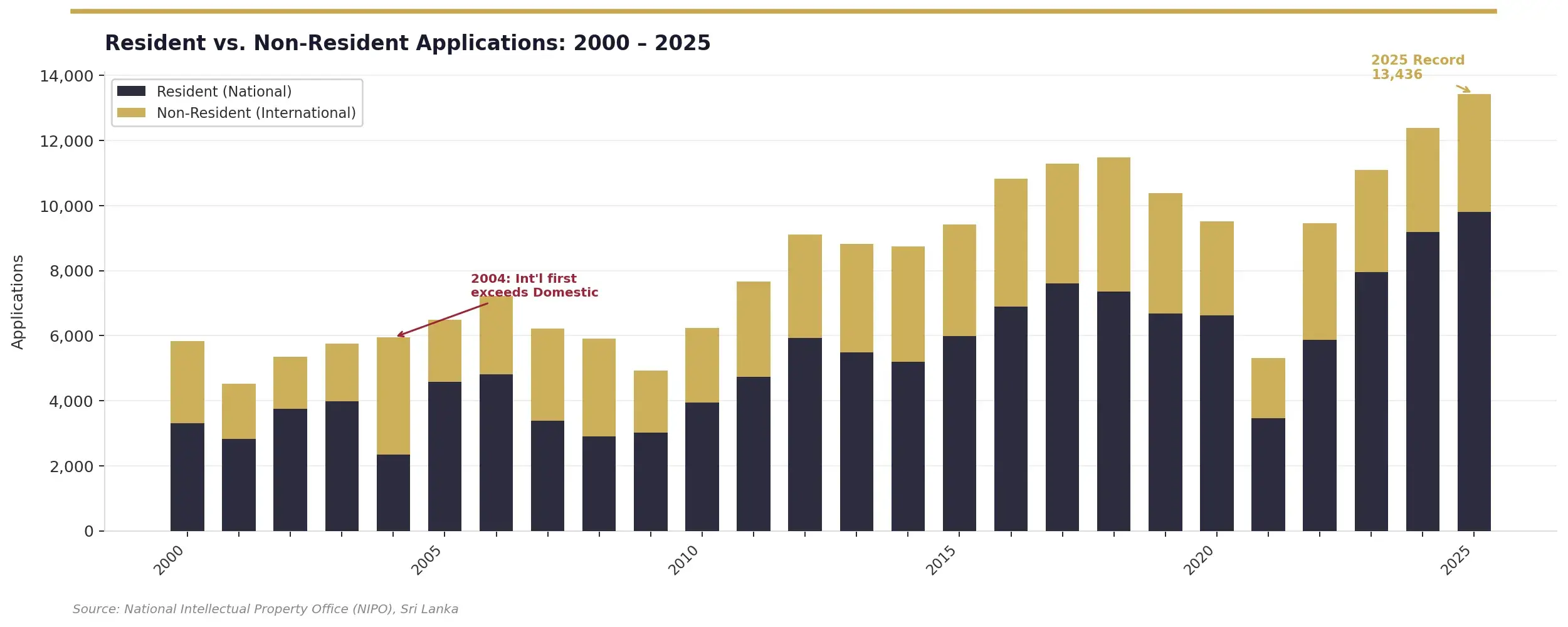
Key structural shift: In 2004, non-resident applications (3,600) outnumbered resident applications (2,343) for the first time, a milestone that reflects growing global confidence in Sri Lanka as a brand market. By 2024, non-residents filed 3,200 applications (25.8% of all filings).
Domestic Vs. International: The International Filing Story
Non-resident (international) applications have consistently represented between 25–35% of all filings over the past decade. Their trajectory tells a story of rising global interest in Sri Lanka’s consumer market.
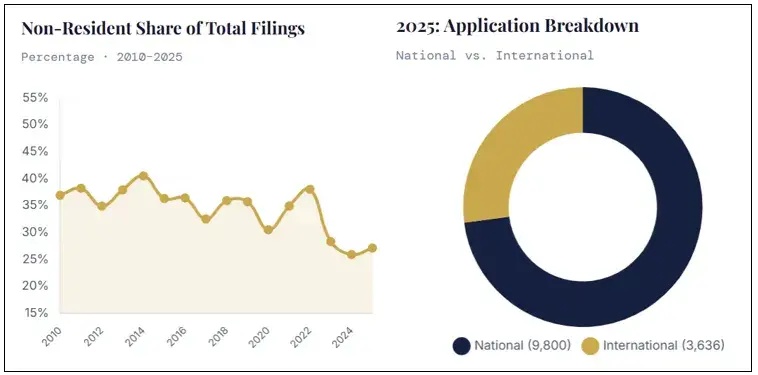
International trademark filings in Sri Lanka reached an all-time high of 4,127 applications in 2018, reflecting robust pre-crisis market confidence. While filing activity softened in subsequent years, international applications have recovered steadily since 2021, rising to 3,636 filings in 2025. The 13.6% increase in international filings in 2025, compared to a 5.3% increase in domestic applications, suggests renewed confidence among foreign brand owners and reinforces Sri Lanka’s attractiveness as a jurisdiction for trademark protection. For businesses expanding across South Asia, these figures signal the continued importance of including Sri Lanka within a comprehensive IP protection strategy.
From Filing to Registration: The Conversion Story
Filing numbers tell only half the story. The rate at which applications convert into actual registrations speaks to the health of the examination system and the quality of applications being filed.
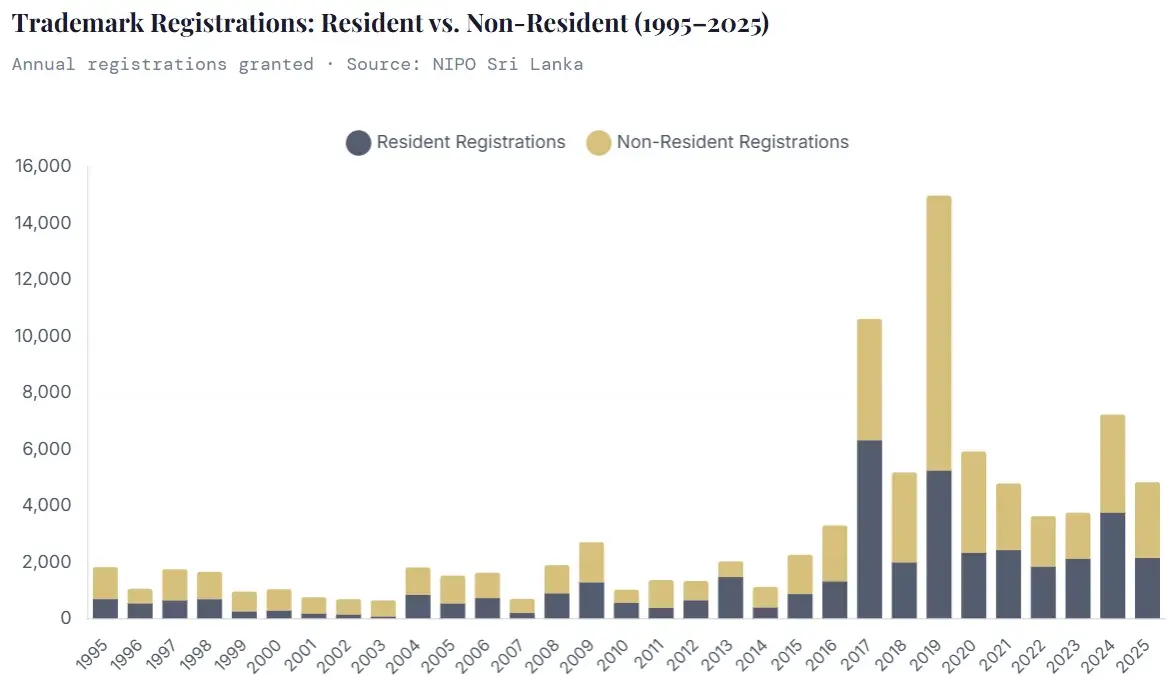
| 4,844 ↑ All-time Record Registrations — 2025 |
7,239 ↑ 2024 Record (prev.) Registrations — 2024 |
36.0% Conversion Rate Reg / Apps Ratio 2025 |
Trademark registrations in Sri Lanka reached a historic high of 7,239 registrations in 2024 (comprising 3,760 resident and 3,479 non-resident registrations). In 2025, registrations moderated to 4,844. This decline should not be interpreted as a reduction in filing activity or market interest; rather, it reflects the inherent time lag between the filing, examination, and eventual registration of trademark applications.
Registration figures for any given year are largely driven by applications filed in preceding years. Given that 13,436 trademark applications were filed in 2025, the highest level recorded in recent years, a corresponding increase in registrations can reasonably be expected in 2026 and 2027 as these applications progress through the registration process. Accordingly, the current registration data points to a robust pipeline of pending applications and continued growth in trademark activity in the years ahead.
2025 Registration Acceptance Rate
Of the 13,436 applications processed in 2025, 12,883 were accepted (95.9%) and 3,889 were rejected. The acceptance rate for national applicants stood at 71.8%, while international applicants achieved a notably higher acceptance rate of 90.7%. This gap merits attention, international filers typically arrive with experienced counsel and pre-cleared marks, producing cleaner applications.
| METRIC | NATIONAL | INTERNATIONAL | TOTAL |
| No. of Applications | 9,800 | 3,636 | 13,436 |
| Substantive Examinations | 12,872 | 4,595 | 17,467 |
| Accepted Applications | 8,846 | 4,037 | 12,883 |
| Rejected Applications | 3,474 | 415 | 3,889 |
| Publications in Govt. Gazette | 3,905 | 3,432 | 7,337 |
| Registrations Granted | 2,161 | 2,683 | 4,844 |
Rejection gap:
National applicants experience a significantly higher rejection rate (27%) compared to international applicants (9%). This disparity highlights a potential area for improvement within the domestic trademark ecosystem. Enhanced trademark awareness, stronger pre-filing clearance and availability searches, and greater emphasis on filing strategies could help improve the quality of local applications and increase their likelihood of progressing to registration. Addressing these factors may contribute to higher conversion rates and a more robust domestic IP landscape.
The 2026 Trajectory: A Strong Opening Quarter
Data for January–March 2026 provides the earliest read on the current year’s trajectory. With 3,375 total applications in just the first quarter, Sri Lanka is on pace for another record year, if the momentum holds.
| 3,375 Q1 2026 Total Applications (Jan–Mar) |
1,978 58.6% of Q1 total National Applications |
1,397 41.4% of Q1 total International Applications |
| METRIC | NATIONAL | INTERNATIONAL | TOTAL |
| Applications | 1,978 | 1,397 | 3,375 |
| Substantive Examinations | 2,001 | 1,014 | 3,015 |
| Accepted Applications | 1,080 | 1,349 | 2,429 |
| Rejected Applications | 462 | 376 | 838 |
| Publications in Govt. Gazette | 1,375 | 1,005 | 2,380 |
| Registrations | 935 | 772 | 1,707 |
Based on Q1 2026 figures, annual trademark filings are projected to reach approximately 13,500 applications, slightly exceeding the record 13,436 filings recorded in 2025. As filing activity typically increases during the course of the year, a full-year total of 14,000–15,000 applications appears achievable.
On the registration side, 1,707 trademarks were registered in Q1 2026, placing registrations on track to exceed recent annual levels if this pace continues throughout the year.
Conclusion
Thirty years of NIPO data points in one direction: Sri Lanka’s trademark market is growing, and it is not stopping for economic crises, global disruptions, or political turbulence. The 2022 crash did not dent filings in any meaningful way. COVID caused a dip, not a collapse. Both times, the market recovered faster than anyone predicted and went on to set new records.
The 2025 figure of 13,436 applications is not a spike, it is the continuation of a trend that has been building for over a decade. International filers are paying attention, with non-resident applications growing at 13.6% in 2025, the fastest pace since before COVID. Domestic filers are catching up too, with Sri Lankan businesses filing at levels never seen before.
There is one number in this data worth sitting with: national applicants face a 27% rejection rate against 9% for international filers. That gap will not close on its own. It points to a real need for better pre-filing advice, stronger search practices, and greater access to IP counsel among local brand owners.
For anyone deciding whether Sri Lanka belongs in their trademark filing strategy, the answer the data gives is straightforward. The market is active, it is growing, and the pipeline of 13,436 applications filed in 2025 means the registry will remain busy through 2026 and 2027. Filing early before the market gets more congested is cheaper, faster, and simpler than managing a conflict after the fact.
Our Coverage on LinkedIn: https://www.linkedin.com/feed/update/urn:li:activity:7481218892284198912