

By Vikrant Rana and Rupin Chopra
INTRODUCTION
As brand identity increasingly moves beyond static logos and wordmarks, businesses are turning to non-traditional forms of trademarks — sounds, holograms, and, increasingly, motion — to distinguish their goods and services in the marketplace. A motion mark, sometimes referred to as a movement mark or animated mark, consists of a moving image or a sequence of images that, taken together, function as a source identifier. Digital interfaces, mobile applications, and audio-visual content have made motion marks an increasingly attractive branding tool, and applicants are beginning to test the boundaries of India’s trademark regime to determine whether, and how, such marks can be registered.
This article examines the statutory basis for the protection of motion marks under Indian law, the practical manner in which such marks have been represented in filings before the Indian Trade Marks Registry, and the interpretive gaps that remain to be addressed.
BACKGROUND
Unlike word marks, device marks, or even three-dimensional marks, a motion mark is inherently defined by change over time — a shape morphing, a gesture unfolding, or an image sequence playing out in a defined order. This temporal quality creates a structural tension with trademark regimes historically built around the depiction of a mark in a fixed, static form.
Several jurisdictions have responded to this by introducing express statutory or regulatory provisions permitting the graphical or digital representation of movement — typically through a sequence of still frames, a short video file, or a verbal description of the movement accompanying the still frames. India, at present, has not enacted an equivalent express provision, leaving applicants to rely on the general definition of a ‘trade mark’ under the existing statute, supplemented by Registry practice.
KEY LEGAL PROVISIONS IN INDIA
The starting point under Indian law is Section 2(1)(zb) of the Trade Marks Act, 1999, which defines a ‘trade mark’ as a mark capable of being represented graphically and capable of distinguishing the goods or services of one person from those of others. Two elements are, therefore, determinative for any mark seeking registration in India — including a motion mark:
- Graphical representability — the mark must be capable of being represented in graphical form; and
- Distinctiveness — the mark must be capable of distinguishing the applicant’s goods or services from those of others.
Unlike jurisdictions that have introduced a specific statutory provision for motion marks, there is presently no equivalent express provision in India. As a result, representation of a motion mark can currently only be achieved indirectly — through a sequence of still images accompanied by a written description, rather than through the direct filing of video files or dynamic/digital representations. Any applicant seeking registration of a motion mark in India must therefore satisfy the general Section 2(1)(zb) test through this still-frame route, in the absence of a dedicated statutory mechanism.
REGISTRY PRACTICE: ILLUSTRATIVE FILINGS IN INDIA
While India does not yet have a codified regime for motion marks, the Trade Marks Registry has, in practice, accepted applications seeking to protect movement-based marks through sequential still-image representation. Two illustrative filings are set out below.
Illustrative Filing 1: Nokia Corporation
| Particular | Detail |
| Motion Trade Mark | Device of Hands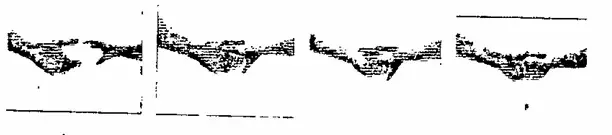
|
| Application Number | 1246341 |
| Application Date | October 28, 2003 |
| Class | 9, 38, 31 |
| Applicant | Nokia Corporation |
| Graphical Representation | Represented through a numbered sequence of still frames depicting a pair of hands in successive positions, accompanied by a description of the movement. |
| Status | Registered until 2023; no longer valid |
Illustrative Filing 2: Toshiba (Kabushiki Kaisha Toshiba)
| Particular | Detail |
| Motion Trade Mark | Toshiba – Movement Trademark (Motion Mark)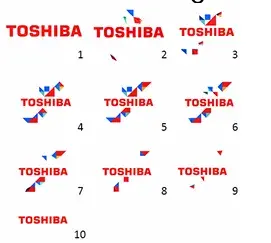
|
| Application Number | 4093005 |
| Application Date | February 19, 2019 |
| Classes | 7, 9, 10, 11, 12, 35, 37, 38, 39, 41, 42 |
| Applicant | Kabushiki Kaisha Toshiba, also trading as Toshiba Corporation |
| Graphical Representation | A trademark that intends to receive trademark registration (hereinafter referred to as “trademark”) is a motion mark consisting of ten figures showing the state of mark change with the passage of time. The numbers displayed in the lower right corner of each figure indicate the order of the drawing, not the elements constituting the trademark. In FIG. 1, only the character of “TOSHIBA” in red is displayed. A plurality of polygons (hereinafter referred to as “polygons”) such as right-angled isosceles triangles, squares, trapezoids, etc. colored in red, blue, light green, light blue, yellow, orange, etc. above and below the character of “TOSHIBA” appear as if someone opens origami (FIGS. 2 to 4). These polygons form like a diagonal line from the lower left to the upper right of “TOSHIBA”. After that, these polygons disappear so that the origami folds (Figs. 6 to 9), and only the character of “TOSHIBA” in red remains (Fig. 10). The movement of the motion mark is about 1 second as a whole.
|
| Status | Registered; valid until 2029 |
Illustrative Filing 3: UPL Ltd.
| Particular | Detail |
| Motion Trade Mark | LOGO – MOVEMENT TRADEMARK (MOTION MARK)
|
| Application Number | 4192672 |
| Application Date | May 30, 2019 |
| Classes | 44 |
| Applicant | Kabu UPL LTD.shiki Kaisha Toshiba, also trading as Toshiba Corporation |
| Status | Registered; valid until 2029 |
ANALYSIS
The still-frame-plus-description approach is a pragmatic solution, but it is not without limitations. A motion mark is, by definition, a continuous and often fluid sequence; reducing it to a finite number of static frames necessarily involves a degree of abstraction, and the adequacy of that abstraction — i.e., whether the frames selected genuinely capture the distinctive character of the movement — is likely to be a fact-specific inquiry in each case. Registry practice has not yet articulated clear guidelines on the number of frames required, the permissible format of the accompanying description, or the standard against which distinctiveness of a motion mark (as opposed to distinctiveness of its constituent static elements) is to be assessed.
The absence of an express statutory provision also creates uncertainty for applicants and their counsel regarding filing strategy — for instance, whether digital/video files may be submitted as a specimen of use in support of an application predicated on still frames, and how enforcement is to proceed against an infringer who replicates the movement but not the individual static frames precisely. Until the Trade Marks Rules or Registry practice directions are amended to expressly address motion marks, applicants would be well advised to build a comprehensive prosecution record — including detailed written descriptions, a sufficient number of sequential frames, and, where possible, evidence of consistent commercial use of the mark in its moving form — to preempt objections at the examination stage.
CONCLUSION
Motion marks represent a natural extension of trademark law’s traditional focus on source-identifying signs into a medium increasingly shaped by digital and audio-visual branding. While the Indian Trade Marks Registry has, through the Nokia and Toshiba filings discussed above, demonstrated a willingness to accept motion marks represented via sequential still frames, the absence of an express statutory provision means that applicants must continue to rely on the general Section 2(1)(zb) framework — capability of graphical representation and distinctiveness — to secure protection. Legislative or rule-based clarity on the specific requirements for motion mark applications would considerably reduce uncertainty for brand owners seeking to protect this emerging category of marks in India.