

By Lucy Rana and Huda Jafri
Introduction
Overview of the Judgment
In a sweeping 250-page judgment pronounced on May 08, 2026, the Hon’ble Delhi High Court upheld the validity of Indian Patent No. 240893, owned by Canadian company Communication Components Antenna Inc. (Plaintiff), for split-sector antenna technology that uses asymmetrical beams to increase subscriber capacity in cellular networks. The Court rejected every ground of revocation raised by the Defendants- including novelty, inventive step, insufficiency, and non-patentability found infringement established, and awarded damages of Rs. 152.32 Crores (approx. USD 18.28 million) computed at a 20 per cent royalty on the Defendants’ total antenna sales. The Court also issued a permanent injunction and granted a certificate of validity under Section 113 of the Patents Act, 1970.
Why This Judgment Is a Landmark?
The ruling is significant in Indian patent law for three principal reasons:
1. The Dartboard Model
The judgment introduces the ‘Dartboard Model’- a conceptual framework formulated by the Court to identify and censure scattershot prior art challenges that cite multiple unrelated documents without establishing any technical or logical linkage between them. The Court expressly cautioned that such an approach, particularly when facilitated by Artificial Intelligence tools and Large Language Models, which can generate large volumes of unrelated citations, is liable to overwhelm patent holders and ought to be dealt with by imposition of heavy costs.
2. MATLAB Simulation as Proof of Infringement
The judgment confirms that MATLAB-based computational simulation of beam patterns, overlaid on a defendant’s own admitted product brochures, constitutes legally sufficient proof of infringement when the accused product is not publicly accessible and has been deliberately withheld from the record.
3. Royalty-Based Damages in Oligopolistic Markets
The judgment authoritatively adopts a royalty-based damages methodology in a specialised oligopolistic market where the infringer’s commercial advantage cannot be attributed solely to the infringing technology. The royalty rate was set at 20 per cent above the rate paid by the bona fide licensee to reflect the Defendants’ bad faith.
Prior Enforcement History
The suit patent has a long enforcement history in India. In proceedings against Mobi Antenna Technology (Shenzhen) Co. Ltd., the patent was upheld and infringement was established. In proceedings against CommScope Technologies LLC (formerly Andrew LLC), the Defendant obtained a global license, and the US Patent Trial and Appeal Board upheld the corresponding US Patent No. 8,311,582. In proceedings against Ace Technologies Corp., an interim injunction was granted on July 12, 2019 on the basis of the same suit patent, anchored by this Court’s perusal of the CommScope license agreement. The present suit is the first fully contested trial on the merits of the patent’s validity and infringement across all grounds.
II. Parties and Case Background
The Plaintiff: Communication Components Antenna Inc.
Communication Components Antenna Inc., is a Canadian company and the successor-in-interest to M/s. TenXc Wireless Inc. (TenXc). TenXc filed the Indian patent application on August 05, 2008 under the Patent Co-operation Treaty (PCT), Application No. 1683/MUMNP/2008, claiming priority from Canadian Application No. 2,540,218 dated March 17, 2006. The patent was granted on June 9, 2010.
TenXc subsequently faced financial difficulties, and in December 2011 its assets were sold. The Plaintiff purchased TenXc’s patent portfolio vide Assignment of Patents Agreement dated January 11, 2012, and was recorded as the registered proprietor by the Indian Patent Office on November 18, 2019. The Plaintiff has sold more than 30,000 antennas in India and maintains a state-of-the-art antenna design facility in Ottawa, Canada.
The Defendants: The Rosenberger Group
The Defendants collectively constitute the Rosenberger Group, comprising four entities:
- Rosenberger Hochfrequenztechnik GmbH and Co. KG, a German company with presence across 22 locations in approximately 13 countries, employing more than 11,000 persons;
- Prose Technologies India Private Limited (formerly Rosenberger Electronic Co. (India) Pvt. Ltd.), an Indian entity that designed, manufactured and sold the infringing antennas;
- Rosenberger Asia Pacific Electronic Co. Ltd., registered in Beijing, China, and a member of standard-setting bodies BSATA and AISG;
- PROSE Technologies (Suzhou) Co. Ltd., incorporated in Kunshan City, Jiangsu Province, China.
It has been alleged that the Defendants sold 1,27,974 infringing antennas in India more than three times the Plaintiff’s 30,000 to customers including Reliance Jio Infocomm Ltd. and Bharti Airtel.
The Suit Patent- IN’893
Subject Matter and Claims
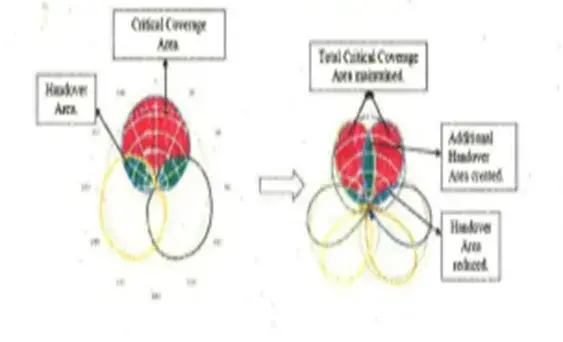
Indian Patent No. 240893, titled ‘Asymmetrical Beams for Spectrum Efficiency’, comprises 25 claims. Claim 1 covers the method and Claim 10 covers the sub-sector antenna itself. The invention addresses a specific problem: as on the priority date of 17 March 2006, increasing sectorisation of antennas to serve more subscribers also increased handover zones, which in turn reduced the dominant ‘critical coverage area’ available for traffic-carrying subscribers.
The invention resolves this by replacing a conventional sector antenna with a split-sector antenna whose sub-sector beams are at least partially asymmetrical, while keeping the total critical coverage area substantially equivalent to that of the replaced antenna. The result is that handover zones are individually reduced, rather than increased, upon replacement.
International Counterparts
The corresponding US Patent No. 8,311,582 was granted on 13 November 2012. An inter partes review filed by CommScope before the US PTAB was rejected on 3 November 2016, and a rehearing request was denied on 15 March 2017. The EPO counterpart application was deemed withdrawn on 14 July 2020 after the Plaintiff did not respond to examination objections for commercial reasons specific to the Indian market. A corresponding Chinese patent was invalidated in July 2013, on grounds specific to Chinese patent law.
III. Issues Before the Court
Vide order dated July 5, 2023, the Court framed the following four issues for adjudication:
- Whether the suit patent IN’893 is liable to be revoked?
- Whether the Defendants are infringing the suit patent?
- Whether the Plaintiff is entitled to a permanent injunction and damages or rendition of accounts, and if so, how much?
IV. Parties’ Arguments and Submissions
A. Plaintiff’s Submissions
On Novelty and Inventive Step
The Plaintiff contended that IN’893 is a valid, fully disclosed and commercially proven patent. On novelty, the Plaintiff argued that no prior art document individually anticipated the specific combination of asymmetrical beam patterns with maintenance of substantially equivalent critical coverage area. On inventive step, the Plaintiff submitted that the prior art documents cited by the Defendants were drawn from unrelated technological fields, including three-dimensional lens antennas, adaptive beam systems, and underlay-overlay networks and that no connectivity or motivation was established between them. The Plaintiff characterised the Defendants’ approach as impermissible hindsight bias.
On Validity Insufficiency
The Plaintiff relied upon the difference between the Indian standard under Section 10 of the Patents Act, 1970 and the standards applied by the EPO and China. The Plaintiff submitted that the EPO requires claims to be clear without reference to the specification, and the Chinese requirement demands all necessary technical features within the claim itself, whereas under Indian law, as confirmed by the Supreme Court in Bishwanath Prasad Radhey Shyam v. Hindustan Metal Industries, claims must be read in the context of the complete specification.
The Plaintiff also submitted that the abandonment of the EPO application was for commercial reasons the technology being more effective in population-dense markets like India and that the Defendants’ Senior Counsel had declined to cross-examine the Plaintiff’s witness on this point, entitling the Court to draw an adverse inference.
On Infringement
The Plaintiff argued that PW-1’s MATLAB simulation, generated using the power and phase weightings disclosed in the patent and compared against the Defendants’ admitted product brochures, established near-identity in beam patterns. The Plaintiff submitted that the Defendants had withdrawn their product brochures from the internet as the suit progressed, making physical testing impossible, and that the Defendants’ failure to produce their own independent simulation data should be treated as adverse to them.
The Plaintiff also relied on Exhibit PW-2/10, a three-way beam pattern comparison prepared by the Defendants themselves for Reliance Jio Infocomm Ltd., showing near-identical beam patterns between the Plaintiff’s and Defendants’ antennas.
On Damages
The Plaintiff sought lost profits on the basis of the Defendants’ sales of 1,27,974 antennas, claiming approximately USD 140 million (approx. Rs. 1,160 crore) in aggregate. In the alternative, the Plaintiff submitted that damages could also be awarded on the basis of the royalty payable under the CommScope licence agreement, at the same rate as CommScope had agreed to pay.
B. Defendants’ Submissions
On Novelty and Inventive Step
On validity, the Defendants mounted a six-ground challenge. On novelty, they cited Documents D-1 through D-11- a collection of US and PCT patent applications, arguing that asymmetrical beam patterns and maintenance of coverage areas were known in the prior art. On inventive step, the Defendants relied on documents D-4 through D-11 and argued that the prior art, particularly Smith-I (US 6480524) and Hagerman (WO 2006/004463), when combined, would have motivated a person skilled in the art to arrive at the invention.
The Defendants also pointed to the prosecution history of the corresponding US patent, arguing that the Plaintiff had to amend its claims before the USPTO to overcome lack of inventive step, implying that the unamended Indian claims were obvious.
On Validity Insufficiency
The Defendants submitted that: (a) the specification did not disclose how to induce asymmetry; (b) power and phase weightings, element spacing, and the meaning of ‘critical coverage area’ and ‘substantially equivalent’ were either absent or too vague; and (c) the EPO examination report dated 12 December 2019 and the Chinese invalidation order dated 5 July 2013 supported the case for insufficiency. The Defendants also argued that the Plaintiff’s own EP application was abandoned after the EPO raised these objections, constituting an admission of insufficiency.
On Infringement- The Gillette Defence
The Defendants set up the Gillette defence, asserting that their antennas are manufactured using the Butler Matrix design, which has been known in the prior art since at least 1982 and which provides no mechanism for inducing or optimising asymmetry. The Defendants submitted that any asymmetry in their beam patterns is uncontrolled and accidental, arising from noise, distortion, and surrounding factors.
The Defendants further argued that PW-1’s MATLAB simulation was reverse-engineered after seeing the Defendants’ brochures, that no product-to-claim comparison had been performed, that the critical coverage area of the Defendants’ antenna had not been independently measured, and that the Plaintiff had failed to show that the peak point analysis establishing asymmetry had been conducted.
On Damages
The Defendants submitted that if damages were to be awarded, the appropriate method was royalty, and the rate should be less than 5 per cent, having regard to the variation in price and demand across the eleven infringing models. The Defendants also contended that the Plaintiff’s antenna did not meet Indian market standards and that their own sales success was attributable to superior technology and competitive pricing rather than infringement.
V. Court’s Analysis
Issue I: Validity of the Suit Patent
A. Novelty
The Court reiterated the settled legal position that for anticipation to be established, the whole of the subject invention must be present in a single prior art document, and that prior art documents cannot be mosaiced with one another. The Court further held, relying on Merck Sharp and Dohme v. Glenmark Pharmaceuticals, that to constitute prior disclosure, the matter relied upon as prior art must be such that, if performed, it would necessarily result in infringement of the patent.
Applying these principles, the Court held that none of Documents D-1 through D-11 anticipated the invention, since none disclosed the specific combination of intentional asymmetrical beam patterns with maintenance of substantially equivalent critical coverage area.
B. Inventive Step: The Dartboard Model
On lack of inventive step, the Court found the Defendants’ evidence to be inadequate. DW-1 admitted he lacked personal technical expertise and had relied entirely on the Defendants’ technical team. DW-2, the expert witness, merely endorsed the pleadings without analysing how the cited prior art documents, in combination, would render the invention obvious.
The Court held that for multiple prior art references to establish obviousness, there must be a link between them, whether through a common field, a common problem, or a common source. The prior art documents cited by the Defendants, drawn from adaptive antenna systems, three-dimensional lens antennas, and underlay-overlay systems, had no such connection.
The Dartboard Model
In this context, the Court formulated the Dartboard Model: the subject invention is the bullseye at the centre of a dartboard, and each prior art citation is a dart thrown at it in the hope of hitting the target. The Court observed that such an approach, particularly in an era of AI tools and Large Language Models that can rapidly generate lists of citations, risks overwhelming patent holders with unrelated prior art at enormous cost to both parties and the judicial system. The Court held that the Dartboard approach ‘ought to be dealt with by imposition of heavy costs’.
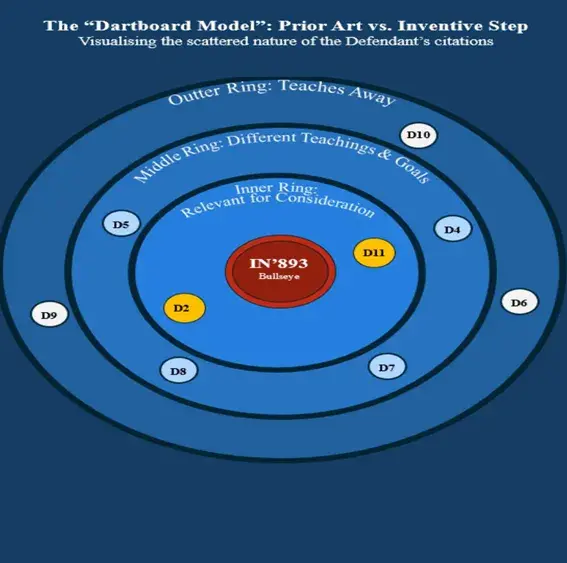
Dartboard Model: Classification of Prior Art Relative to Suit Patent IN’893 — Reproduced from the Judgment (p. 122)
C. Insufficiency of Disclosure: India vs. EPO and China
Comparative Legal Standard. The Court conducted a detailed comparative analysis of the legal standards applied in three jurisdictions. Under the EPO’s Article 84, claims must be clear and supported by the description without reference to the specification. Under China’s Rule 21, an independent claim must record all necessary technical features within the claim itself. Under India’s Section 10 of the Patents Act, 1970, the Supreme Court in Bishwanath Prasad Radhey Shyam v. Hindustan Metal Industries has unambiguously held that the specification and claims must be looked at and construed together, and that the proper approach is to read the description first so as to prepare the mind for what is claimed.
The Court held that foreign rejection decisions do not, on their own, satisfy the ground of insufficiency under Indian law. On the abandonment of the EPO application, the Court noted that the Plaintiff’s witness had explained that the application was not pursued for commercial reasons, as the technology is more relevant in population-dense markets like India, and that the Defendants’ Senior Counsel had chosen not to cross-examine this witness on this point.
Construction of Key Terms.
On the individual terms, the Court held:
‘Critical Coverage Area’: though not expressly defined, is understandable to a person skilled in the art as the dominant signal area of a sector, i.e., coverage area minus handover area, and need not be defined with mathematical precision.
‘Substantially Equivalent’: simply means that the replacement antenna continues to maintain the effective coverage area of the earlier antenna.
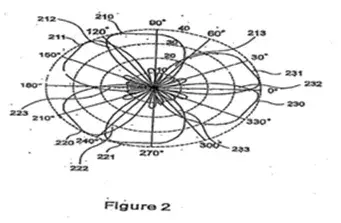
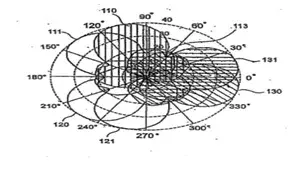
‘Asymmetry’: refers to optimised or induced asymmetry along the line of reference passing through the peak gain point of the main beam in the horizontal plane, not uncontrolled asymmetry caused by noise, distortion, or topography.
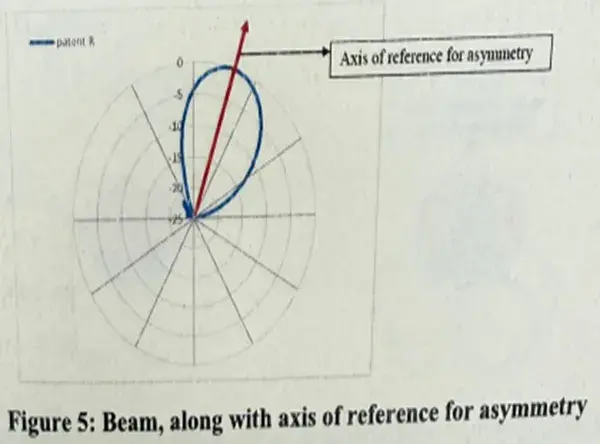
Figure 5 of IN’893: Asymmetrical Beam with Axis of Reference, Distinguished from Gabriel Prior Art Horizontal Beam Patterns — Reproduced from the Judgment (p. 83)
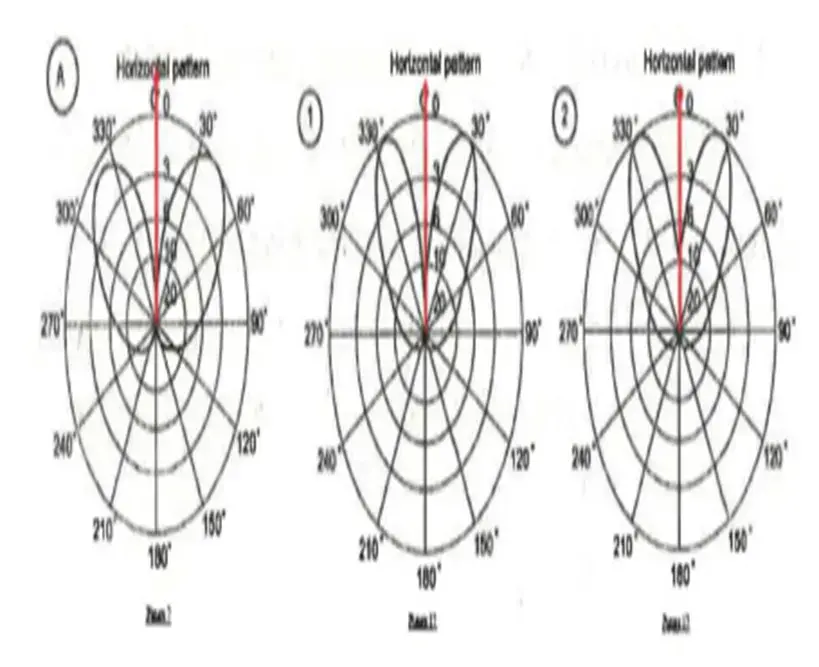
Critical Coverage Area: Prior Art Symmetrical Beams (top, coverage not maintained) vs. IN’893 Asymmetrical Beams (bottom, coverage maintained) — Reproduced from the Judgment (p. 137)
On False Representation — Sections 64(1)(i), (j), and (k). The Court found that neither DW-1 nor DW-2 had personally simulated beam patterns from the patent’s power and phase weightings. DW-2 admitted he had conducted a simulation but had not placed it on record, and confirmed that his reason for not doing so was that the information disclosed in the patent was ‘not sufficient’. The Court held that absent any simulation demonstrating that the disclosed weightings cannot produce the beam shapes in the specification, the ground could not stand. On Sections 64(1)(i) and 64(1)(k), the Court noted a fatal internal contradiction: the Defendants simultaneously argued the invention is a natural phenomenon and a mental act, which are mutually exclusive.
Issue II- Infringement
A. Evidentiary Framework: The MATLAB Simulation Methodology
The Court addressed the evidentiary challenge upfront. The Defendants’ antennas are customised industrial products, not available off the shelf, and neither party had access to the other’s physical antenna. The Defendants had also removed their product brochures from the internet during the pendency of the suit, which the Court described as conduct that was ‘suspect to say the least’.
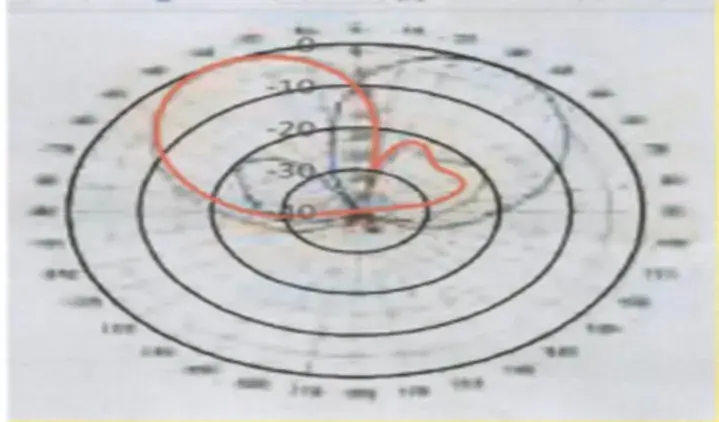
PW-1 generated beam patterns using MATLAB by inputting the power and phase weightings disclosed in IN’893, deriving element spacing from the standard half-wavelength formula at the relevant frequency, and using a simple cosine function to represent the single element pattern. The outputs were overlaid on beam patterns from the Defendants’ admitted product brochures, showing near-identical patterns. The Court observed that DW-2 himself had stated in his affidavit that element spacing can be derived from the cosine function, and had admitted in cross-examination that he had generated a simulation but chosen not to file it. With these admissions, PW-1’s methodology stood proved.
Patent Specification Figures 1 and 2: Beam Pattern Configurations of the Split-Sector Antenna IN’893 — Reproduced from the Judgment (p. 162)
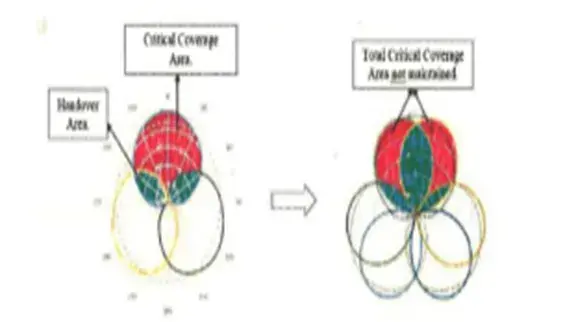
MATLAB Overlay: Beam Patterns of IN’893 (Orange and Blue) Overlaid on Rosenberger’s Antenna at 40dB Scale, 2300–2400 MHz — Reproduced from the Judgment (p. 175)
B. The Gillette Defence: Butler Matrix vs. Blass Matrix
The Court found the Butler Matrix defence unsupported on the evidence. DW-2 stated that the Defendants applied the Butler Matrix to the antenna architecture of the Wästberg patent (US 6608591 B2). However, in cross-examination, DW-2 admitted that the Wästberg patent is actually based on a Blass Matrix and a Nolan Matrix, not a Butler Matrix. The Wästberg patent’s own text, as extracted by the Court, confirmed this. Accordingly, the foundational premise of the Gillette defence was not made out on the evidence.
C. The Three-Way Beam Pattern Comparison: Exhibit PW-2/10
Exhibit PW-2/10 proved decisive. This was a document prepared by the Defendants themselves for Reliance Jio Infocomm Ltd. comparing the beam patterns of Rosenberger, Ace Technologies Corp., and the Plaintiff. The document showed near-identical patterns and stated that Rosenberger had optimised its side-lobes and suppressed its backlobes by more than 30 dB against the 27 dB in the Plaintiff’s antenna. The Court held that if the Defendants’ antennas did not embody the same technology as the Plaintiff’s, there would have been no commercial rationale for making this comparison to their customer in the first place.
Defendants’ Own Three-Way Beam Pattern Comparison — Rosenberger, ACE Technologies and Plaintiff (CCA), Prepared by the Defendants for RJIL (Exhibit PW-2/10) — Reproduced from the Judgment (p. 209)
Issue III — Damages: Royalty Methodology
A. Rejection of Lost Profits
The Court declined to award damages on the basis of lost profits, holding that in a specialised oligopolistic market with limited sellers and buyers, the Defendants’ sales advantage may be attributable to multiple non-infringing competitive factors including lower pricing, stronger marketing, after-sales service, and supply chain capacity. PW-2 confirmed in cross-examination that RJIL had communicated orally that it preferred the Defendants’ antenna partly because the side-lobe level was slightly better, and that pricing played a significant role in the Plaintiff’s lost orders. The Court similarly declined to award damages on the basis of price erosion, finding that the Plaintiff had itself reduced prices on multiple occasions in response to competition, and that infringement alone could not be the sole blameworthy cause.
B. Adoption of the Royalty Method and Rate-Setting
The Court instead adopted the royalty method, drawing on the passage from Terrell on the Law of Patents that damages in a licensing context are generally equal to the royalty the infringer would have paid for a licence. Both parties had in their pleadings accepted royalty as a legitimate measure. The Court perused the CommScope licence agreement (in sealed cover), which had also served as the basis for the 10 per cent interim deposit directed in 2019 and upheld by the Division Bench and the Supreme Court.
The Court additionally noted that the Defendants had failed to file any Freedom to Operate search report, demonstrating a lack of good-faith pre-launch due diligence. In these circumstances, the Court fixed the royalty rate at 20 per cent of total sales, noting that an infringer who has not negotiated in good faith should not be placed in the same position as a bona fide licensee.
C. Currency Conversion
The Court applied the exchange rate of Rs. 94.6510 per USD prevailing on 30 March 2026, in accordance with the Supreme Court’s decision in DLF Ltd. v. Koncar Generators and Motors Ltd., which holds that the date of the decree is the appropriate date for converting foreign currency claims.
VI. Findings and What Was Held
Issue I — Validity: Summary of Findings
The Court held that the suit patent IN’893 is valid on all grounds:
Section 64(1)(e) — Lack of Novelty: Rejected. No prior art document individually anticipated the invention.
Section 64(1)(f) — Lack of Inventive Step: Rejected. The Defendants’ prior art citations were drawn from unrelated technological fields with no established linkage.
Section 64(1)(h) — Insufficiency: Rejected. Indian law requires claims to be read with the specification; EPO and Chinese rejection decisions are not determinative of the Indian standard.
Section 64(1)(j) — False Representation: Rejected. Neither Defendants’ witness had simulated the beam patterns.
Sections 64(1)(i) and 64(1)(k): Rejected as internally contradictory and unsupported.
Issue II — Infringement: Feature-by-Feature Analysis
The Court held that infringement of IN’893 by the Defendants was established. The relevant findings, as tabulated in the judgment, are reproduced below:
| S.No. | Feature of Suit Patent | Defendants’ Products |
| 1 | Split Sector Antenna | Yes |
| 2 | Asymmetrical Beam Pattern | Yes — clear from the Defendants’ product brochures |
| 3 | Critical Coverage Area Maintained | Yes — proved on the basis of evidence |
| 4 | Reduction in Handover Zones | Yes |
The Court further held that since PW-1’s MATLAB simulation stood proved through DW-2’s own admissions in cross-examination, and since the Defendants had withheld their own beam pattern data, the only reasonable inference was that infringement was established. The Gillette defence, based on use of Butler Matrix, was rejected as not made out on the evidence, since the Wästberg patent relied upon by the Defendants actually describes a Blass Matrix and Nolan Matrix.
Issue III: Damages Computation
The Court held that damages were to be computed on a royalty basis at 20 per cent of the Defendants’ total admitted sales. The sales figures and the final computation are set out below:
| Model | Currency | Total Sales |
| MB-4Q9X30V-00 | USD | 46,971,500.00 |
| MB-2B6X30V-10 | USD | 13,974,491.60 |
| Grand Total (USD) | — | 60,945,991.60 |
| MB-4Q9X30V-00 | INR | 97,76,91,270.35 |
| MB-2B6X30V-10 | INR | 34,21,32,750.00 |
| MB-4W8X33V-10 | INR | 6,06,78,700.00 |
| S-Wave U/U-33-20DV10-BS | INR | 6,15,42,566.10 |
| S-Wave EW/EW-33-20DV10-BS | INR | 11,64,01,592.77 |
| MB-4W8X33V-01 | INR | 28,89,00,300.00 |
| Grand Total (INR) | — | 1,84,73,47,179.22 |
| Component | Amount (Rs.) |
| Royalty on USD sales — 20% of USD 60,945,991.60 @ Rs. 94.6510 | 1,15,37,67,348.06 |
| Royalty on INR sales — 20% of Rs. 1,84,73,47,179.22 | 36,94,69,435.84 |
| Total Damages Decreed | 1,52,32,36,783.90 |
Reliefs Granted
- Permanent Injunction: The Defendants were permanently restrained from manufacturing, using, distributing, selling, offering for sale, or importing into India any product infringing IN’893, including the eleven identified infringing models and any other infringing models.
- Damages: A decree for Rs. 1,52,32,36,783.90 was passed, payable by 30 June 2026. Simple interest at 7% per annum to apply from 1 July 2026 on default.
- Additional Damages: Updated sales affidavits to be filed within four weeks; additional damages at 20% of such further sales to be paid by 30 June 2026.
- Costs: Taxed costs awarded to the Plaintiff, to be determined by the Taxation Officer.
VII. Conclusion
Significance and Takeaways
The judgment in Communication Components Antenna Inc. v. Rosenberger Hochfrequenztechnik GmbH and Co. KG and Ors. is a landmark in Indian telecommunications patent law. It establishes that India applies its own standard for sufficiency of disclosure, independent of EPO or Chinese outcomes. It confirms that MATLAB-based simulation can discharge the initial burden of proving infringement where the accused product is withheld. It introduces the Dartboard Model as a practical tool for courts to identify and sanction unfocused prior art challenges, including those generated by AI-assisted search tools. It adopts a principled royalty-based damages methodology calibrated to a real licence agreement as a floor, with an uplift to reflect the infringer’s bad faith.
Summary of Legal Principles Established
- India’s sufficiency standard is independent of EPO or Chinese patent office outcomes.
- MATLAB-based simulation overlaid on admitted product brochures is sufficient proof of infringement where physical testing is impossible.
- Scattershot prior art challenges, including those AI-assisted, may attract heavy costs under the Dartboard Model.
- In oligopolistic markets, royalty is the preferred damages method; bad-faith infringers attract a higher rate than bona fide licensees.
- The date of the decree is the appropriate date for converting foreign currency damages.
1 Communication Components Antenna Inc. v. Rosenberger Hochfrequenztechnik GmbH and Co. KG and Ors., CS(COMM) 653/2019 and CC(COMM) 22/2022, High Court of Delhi at New Delhi, judgment pronounced on 30 March 2026, Justice Prathiba M. Singh.
2 Communication Components Antenna Inc. v. Mobi Antenna Technology (Shenzhen) Co. Ltd. and Ors., CS(Comm.) 977/2016 (renumbered from CS(OS) 1989/2010), High Court of Delhi, judgment dated 16 May 2024.
3 Communication Components Antenna Inc. v. Ace Technologies Corp. and Ors., CS(Comm.) 1222/2018, High Court of Delhi, interim judgment dated 12 July 2019.
4 CS(COMM) 653/2019.
5 Bishwanath Prasad Radhey Shyam v. Hindustan Metal Industries, MANU/SC/0255/1978, Supreme Court of India.
6 Merck Sharp and Dohme v. Glenmark Pharmaceuticals, 2015 (63) PTC 257 (Del.), Division Bench, Delhi High Court.
8 Terrell on the Law of Patents, Sweet and Maxwell, 18th Edition, 2016.
9 Ace Technologies Corp. and Ors. v. Communication Components Antenna Inc., FAO(OS)(COMM) 186/2019, Division Bench of the Delhi High Court, order dated 10 April 2023.
10 DLF Ltd. v. Koncar Generators and Motors Ltd., 2024 SCC OnLine SC 1907, Supreme Court of India.
Our Coverage on LinkedIn: https://www.linkedin.com/feed/update/urn:li:activity:7459496557130993664