

By Vikrant Rana and Huda Jafri
INTRODUCTION
“Oo La La La La Le O”, a tune instantly recognisable to millions of Indians, is no longer just an advertising jingle. United Breweries Limited has secured trade mark registration for the iconic Kingfisher melody, transforming a nostalgic brand anthem into a legally protected sound mark under the Trade Marks Act, 1999[1]. Granted with effect from 31 January 2025 and published in the Trade Marks Journal on 6 October 2025, the registration marks another step in India’s evolving approach to non conventional trade marks.
For nearly three decades the Kingfisher jingle has echoed across television commercials, cricket sponsorships, concerts and promotional campaigns, embedding itself deeply in public memory and often recognisable even without the accompanying logo or visuals. With this registration, a cultural advertising cue now enjoys enforceable statutory protection as a distinctive brand identifier.
THE REGISTRATION
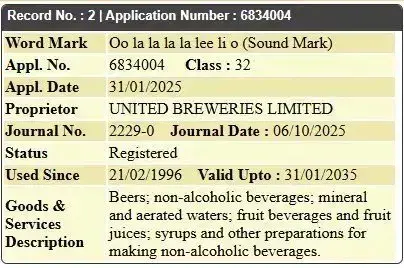
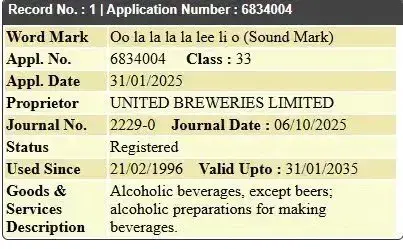
The application was filed as a multiclass sound mark under Section 18(2)[2] of the Trade Marks Act, 1999, and described as an “Instrumental Melody (Sound Mark)”. The Trade Marks Registry granted protection across Classes 32 and 33, covering beers, non alcoholic beverages, alcoholic beverages and related beverage preparations.
 |
 |
| Registry record, Class 32 (non alcoholic beverages). |
Registry record, Class 33 (alcoholic beverages). |
LEGAL FRAMEWORK FOR SOUND MARKS IN INDIA
Although the Trade Marks Act, 1999 does not expressly define “sound marks”, Indian law recognises them through the broad definition of a trade mark under Section 2(1)(zb)[3], which includes any mark capable of graphical representation and of distinguishing the goods or services of one trader from those of another.
Formal procedural recognition arrived with Rule 26(5) of the Trade Marks Rules, 2017[4], which specifically governs sound mark applications. The Rule requires:
- submission of the sound in MP3 format;
- a duration not exceeding thirty seconds; and
- accompanying graphical representation, generally through musical notation.
The Kingfisher registration reflects the increasing commercial importance of sonic branding in India. Auditory branding has become an increasingly valuable tool for creating immediate consumer recall, particularly in sectors driven heavily by advertising and emotional association.
IMPORTANCE OF SONIC BRANDING
The registration also highlights the growing strategic value of sonic branding within modern advertising and intellectual property practice.
Sound marks occupy a unique commercial position because they engage consumer memory differently from visual branding. Well designed audio cues often produce immediate recall and emotional association, making them particularly valuable in digital advertising, streaming platforms, mobile applications and broadcast media.
India’s register of sound marks, though still comparatively limited, has expanded steadily over the past decade. Notable examples include:
| Registration No. | Proprietor | Mark | Depiction | Class |
| 4350871 | Saregama India Limited | YOODLEE | 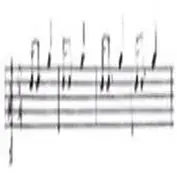 |
42 |
| 4104213 | Mastercard International Incorporated | Mastercard acceptance tone | 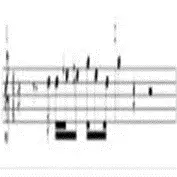 |
9 |
| 1748778 | M/s. Edgar Rice Burroughs Inc. | TARZAN YELL | 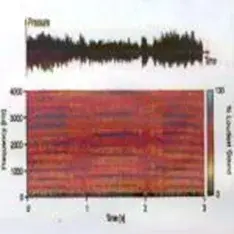 |
41 |
| 1904243 | Britannia Industries Limited | TING TING TI TING | 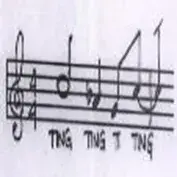 |
29 |
The Kingfisher registration joins this relatively small but commercially influential category of protected sonic identifiers.
CHALLENGES IN PROTECTING SOUND MARKS
Despite growing recognition, sound marks continue to present unique legal and practical challenges.
One of the most significant difficulties concerns graphical representation. Musical notation provides legal precision but may not fully capture the commercial impression of a sound, and the issue becomes more complicated for non musical sounds such as engine noises, ambient tones or mechanical audio signatures.
Distinctiveness also remains a substantial hurdle. Simple or commonly used sounds are unlikely to qualify for protection unless extensive evidence demonstrates acquired distinctiveness.
A further recurring issue is the overlap between copyright and trade mark protection. Since jingles frequently qualify as copyrighted musical works, applicants must ensure that ownership in the underlying composition is clearly secured before pursuing trade mark registration.
The Kingfisher registration nonetheless demonstrates that these challenges can be overcome where a sound possesses strong commercial identity, long standing use and clear public association with a single source.
COMMERCIAL SIGNIFICANCE FOR UNITED BREWERIES
For United Breweries Limited, the registration represents more than symbolic recognition. It secures proprietary rights over a core element of the company’s brand architecture.
The multiclass filing strategy is commercially important because it protects the jingle across both alcoholic and non alcoholic beverage categories, reflecting the broader expansion of the Kingfisher brand portfolio.
The registration also strengthens enforcement capability. Instead of relying solely on passing off principles, the company may now pursue infringement actions directly where competing businesses adopt confusingly similar sonic branding.
From a broader market perspective, the development signals that Indian intellectual property practice increasingly treats auditory branding as a serious and protectable commercial asset.
KEY TAKEAWAYS
For Brand Owners Considering a Sound Mark
- Secure ownership of the underlying musical composition, typically through copyright assignment or a work for hire arrangement, before filing, since jingles usually qualify as copyrighted works in their own right.
- Prepare an accurate graphical representation, generally musical notation, and keep the submitted MP3 clip within the thirty second limit under Rule 26(5) of the Trade Marks Rules, 2017.
- Build a record of long standing, consistent use across advertising and sponsorships; distinctiveness for simple or common sounds is rarely accepted without strong evidence of this kind.
For Businesses Managing a Brand Portfolio
- Consider multiclass filing where a sound is used across related product categories, so protection keeps pace with the brand’s actual commercial footprint.
- Treat a registered sound mark as a direct infringement tool, not merely a passing off asset, when responding to confusingly similar audio branding by competitors.
CONCLUSION
The registration of the Kingfisher “Oo La La La La Le O” jingle as a sound mark represents a notable development in India’s trade mark and branding landscape, underscoring the commercial value of non traditional brand assets.
For United Breweries Limited, the registration strengthens brand protection by securing exclusive rights over one of its most enduring and high recognition advertising assets, built through nearly three decades of consistent market use. It enhances the company’s ability to safeguard its brand identity across advertising, sponsorships and promotional platforms in a highly competitive consumer market.
More broadly, the development reflects the increasing recognition of sonic branding as a strategic business tool and reinforces the growing scope of intellectual property protection for distinctive non visual brand identifiers in India.
[1] Trade Marks Registry, Application No. 6834004, Trade Marks Journal No. 2229-0 dated 6 October 2025.
[2] The Trade Marks Act, 1999, Section 18(2).
[3] The Trade Marks Act, 1999, Section 2(1)(zb).
[4] The Trade Marks Rules, 2017, Rule 26(5).
Our Coverage on LinkedIn:
https://www.linkedin.com/feed/update/urn:li:activity:7497892916850294784