

By Vikrant Rana and Pallavi Paul
Introduction
Can a market giant monopolise a descriptive prefix simply because it built a powerful brand around it? The Madras High Court says no. By a common order dated January 6, 2026, the Court dismissed three Original Petitions filed by The Procter & Gamble Company (“P&G”), one of the world’s largest consumer goods conglomerates, seeking to cancel the trade mark registrations of an Indian enterprise, IPI India Private Limited (“IPI India”). The Hon’ble Court, presided over by Justice N. Senthilkumar, ruled that the marks ‘VAPORIN,’ ‘VAPORIN COLD RUB,’ and ‘Vapor In, Stress Out. Anytime, Anywhere’ are neither deceptively similar to P&G’s ‘VICKS VAPORUB’ nor adopted with dishonest intent, and that the shared prefix ‘VAPO’ is descriptive, common to trade, and publici juris.
Background and Parties
P&G is a US-based company, founded in 1837, that owns the internationally recognised VICKS brand, marketed and sold in India since 1964. The VICKS brand includes several related marks such as VICKS VAPORUB, VICKS VAPOCOOL, VICKS VAPOPATCH, VICKS VAPOEASE, VICKS COUGH DROPS and VICKS VAPOSYRUP, among others. The trade mark VICKS has been registered in India since 1954 and ‘VAPORUB’ since 1977, with numerous other VAPO-formative marks registered across Classes 03, 05 and 30 at various points thereafter, including:
| Registration No. | Trade Mark | Application Date | Class |
| 162610 | 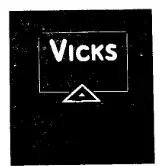 |
February 1, 1954 | 05 |
| 328354 | VAPORUB | August 30, 1977 | 05 |
| 1974989 | VICKS VAPORUB | June 4, 2010 | 05 |
| 1564959 |  |
June 4, 2007 | 05 |
| 575530 | VICKS VAPOSYRUP | June 19, 1992 | 05 |
| 1994236 | VAPOCOOL | July 15, 2010 | 05, 30 |
| 2162714 | VAPOINHALER | June 20, 2011 | 05 |
| 5222974 | VAPOPATCH | November 25, 2021 | 03 |
| 5425412 | VAPOSTEAM | April 27, 2022 | 05 |
| 1501137 | 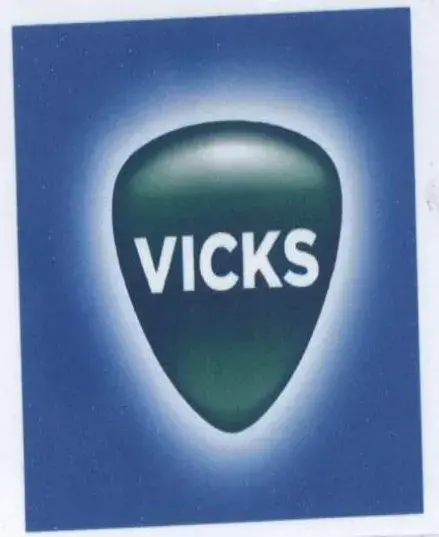 |
November 3, 2006 | 03, 05, 30 |
P&G also claimed well-known trade mark status for VICKS.
IPI India is an Indian company that has been manufacturing and selling vapour-based products under the brand VAPORIN since 2013 – nearly a decade before P&G’s objection. IPI’s device mark  was registered vide application No. 3462733 dated January 20, 2017 (certificate No. 1604307 dated July 14, 2017); its VAPORIN word mark was registered under Class 03 vide application No. 3897775 dated July 25, 2018; and VAPORIN COLD RUB was registered under Class 05 vide application No. 4285435. IPI also placed on record foreign registrations for related marks, including DR. S. WONG’S VAPORIN INHALANT, VAPORIN AIR SANITIZER, and VAPORIN AROMATHERAPY. IPI’s products are actively marketed across India through various channels, including metro train advertisements and e-commerce platforms.
Upon discovering IPI’s activities, P&G issued a cease-and-desist notice on September 27, 2022, and subsequently filed petitions under Sections 47, 57 and 125 of the Trade Marks Act, 1999, seeking rectification of three of IPI’s registrations:
| O.P. No. | Registration No. | Mark | Class |
| O.P.(TM) No.48 of 2024 | 3897775 | VAPORIN | 03 |
| O.P.(TM) No.49 of 2024 | 4285435 | VAPORIN COLD RUB | 05 |
| O.P.(TM) No.50 of 2024 | 3461733* |  |
03 |
* The registration number for O.P.(TM) No.50 of 2024 is stated as 3461733 in the order’s prayer clause and as 3462733 elsewhere in the order (para 16);
Notably, IPI India, the defendant in the present case, also contended before the Court that a related infringement proceeding between the same parties, concerning the very question of whether IPI’s use of the mark infringes P&G’s trade mark, is pending before the Hon’ble High Court of Bombay, and that P&G was under a duty to disclose the pendency of that proceeding to the Madras High Court, a submission the Court’s order records but does not appear to have separately adjudicated in its final reasoning.
The Contentions
P&G’s Case
- Priority and reputation: P&G’s marks predate IPI’s by decades, and VAPORUB holds independent brand value, goodwill, and registration distinct from the house mark VICKS.
- Deceptive similarity: The marks VAPORUB and VAPORIN share the prefix VAPO and are alleged to be phonetically, visually, structurally, and conceptually similar when compared as a whole, from the perspective of an average consumer with imperfect recollection — the standard drawn from the landmark ruling in Amritdhara Pharmacy v. Satya Deo Gupta[1].
- Trade dress and packaging: The bottle, size, dimension, colour scheme, and overall trade dress of IPI’s product were contended to be deceptively similar to P&G’s packaging thereby, constituting an attempt to ride on P&G’s goodwill.
- Dishonest adoption: The choice of the nearly identical prefix VAPO was alleged to be a deliberate and dishonest attempt to associate with P&G’s established VAPO-formative marks.
In addition to the case law above, P&G’s counsel relied on Sections 9 and 10 of the Trade Marks Act, 1999 — the absolute grounds for refusal of registration and the limitation as to colour — and, beyond Amritdhara case, cited Parle Products (P) Ltd. v. J.P. and Co., Mysore [2], Indian Hotels Company Ltd. v. Jiva Institute of Vedic Science and Culture[3], Ultra Tech Cement Ltd. v. Alaknanda Cement Pvt. Ltd.[4], and Neon Laboratories Ltd. v. Themis Medicare Ltd.[5], in support of the ‘overall similarity/imperfect recollection’ test and against the respondent’s publici juris defence.
IPI India’s Defence
- VICKS is the badge of origin: The dominant and source-identifying element in P&G’s product is VICKS, not VAPORUB. It is VICKS that consumers associate with P&G, and VAPORUB is merely descriptive of the product’s nature, i.e., a vapour rub formulation.
- No registration for the mark VAPO alone: P&G holds no standalone registration for VAPO or VAPOUR, both of which are ordinary English words/abbreviations that are descriptive and common to the trade. P&G cannot, therefore, claim exclusivity over a generic prefix.
- Marks must be compared as a whole: Under Section 17 of the Trade Marks Act, 1999, a trade mark must be viewed in its entirety; thus, when taken as a whole, VICKS VAPORUB and VAPORIN are structurally, visually, and phonetically distinct.
- VAPO is publici juris: The term VAPO is a widely used abbreviation of vapour in the trade. IPI placed before the Court a list of 75 words beginning with VAPO, together with evidence of numerous third-party products in the same trade using VAPO- or vapour-prefixed names – among them Softskin Vaporizing Chest Rub, Menthodex Vaporizing Rub, Careway Vapour Rub, Mentholatum Vapour Rub, SnuffleBabe Vapour Rub, and Numark Vapour Rub. IPI argued that no single trader can arrogate to itself the exclusive right to use a word that has entered the public domain.
- Long use and passive acquiescence: IPI has continuously used and promoted VAPORIN since 2013, a period of nearly a decade before P&G’s cease-and-desist notice. P&G’s prolonged inaction was argued to amount to passive consent under Section 33 of the Trade Marks Act, 1999.
IPI India’s counsel also relied on Sections 2(m) and 2(zb) of the Trade Marks Act, 1999 (the statutory definitions of ‘mark’ and ‘trade mark’) and, in addition to the authorities discussed below, on J.R. Kapoor v. Micronix India[6] , which held that a common technical or descriptive prefix (there, ‘micro’) cannot have a monopoly claim where the uncommon elements of the competing marks are themselves dissimilar.
The products in question
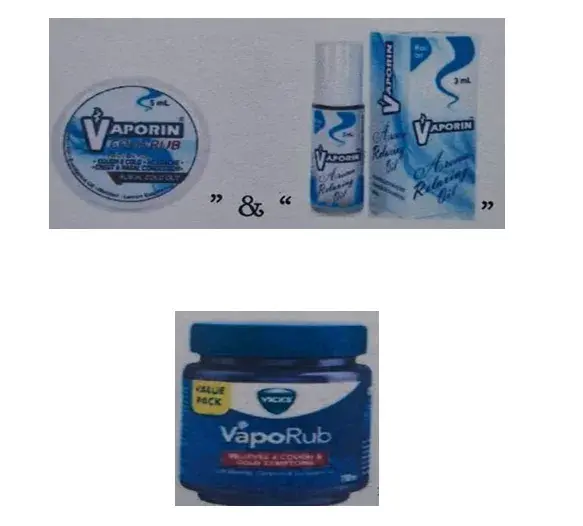
*Image taken from court order
Judicial Reasoning
The Court framed three issues for determination:
- Whether VICKS VAPORUB and IPI’s marks VAPORIN and VAPORIN COLD RUB are deceptively similar.
- Whether the adoption of these marks by IPI was done with dishonest intent.
- Whether the term VAPO is publici juris.
Court’s Order and Observations:
On Deceptive Similarity
Applying the standard of the average man of ordinary intelligence and imperfect recollection, as articulated by the Hon’ble Supreme Court in Amritdhara and Parle Products (P) Ltd. v. J.P. & Co., Mysore[7], the Court found that when the rival marks are compared as a whole without dissection, they are not similar. The visual appearance of the marks is distinct, and the colour, size, packaging, and letter configuration are not deceptively similar. The Court declined to adopt P&G’s approach of isolating VAPO as the dominant feature, holding this to be an impermissible dissection of a composite mark, contrary to both Section 17 of the Act and the settled principle that trade marks must be compared in their totality.
On Dishonest Intention
The Court noted that many products beginning with the term VAPO were available and common in the trade. Given the widespread use of the prefix across the industry, the Court concluded that IPI’s adoption of VAPORIN could not be characterised as dishonest. The Court was of the view that there could be no monopoly over a descriptive prefix in common commercial parlance.
On VAPO Being Publici Juris
The Court held that VAPO is merely an abbreviation of the ordinary English word vapour, is descriptive term for vapour-based or vapour-action medicinal preparations, and has become part of the public domain – publici juris -in the relevant trade. Drawing on the Supreme Court’s ruling in F. Hoffmann-La Roche & Co. Ltd. v. Geoffrey Manners & Co. Private Ltd[8]. and the Delhi High Court’s decision in Scherring Corporation v. Alkem Laboratories Limited[9], the Court affirmed the established principle that where a common feature in two competing marks is descriptive and publici juris, consumers will tend to disregard that common feature and pay greater attention to the uncommon elements.
Critical Analysis
One of P&G’s contentions was that its extensive portfolio of VAPO-formative marks -VAPOCOOL, VAPOINHALER, VAPOPATCH – created a family of marks entitling it to broader protection against any VAPO-prefixed product. The Court implicitly rejected this argument by finding that VAPO is itself generic. The family-of-marks doctrine, even where recognized, cannot be invoked to monopolise a descriptive element that belongs to the trade at large.
IPI’s argument under Section 33 of the Trade Marks Act that P&G’s inaction for nearly a decade amounted to passive consent was a potent one, though the Court arrived at its conclusion primarily on the merits without explicitly adjudicating on acquiescence. This nonetheless serves as a practical lesson for brand owners that vigilance is not merely a strategic choice but a legal necessity. IPI’s submission regarding the pendency of a parallel infringement suit before the Bombay High Court – and P&G’s alleged duty to disclose it – raises a forum-conduct point that merits attention in the parties’ further proceedings, even though the Madras High Court did not rest its decision on this ground.
Conclusion
The dismissal of P&G’s petitions in Procter & Gamble v. IPI India is a well-reasoned application of settled trade mark principles to a commercially significant dispute. It reinforces several important propositions:
- A well-known mark does not confer a blanket right to suppress competitors who use descriptive, generic, or common-to-trade elements.
- Trade mark comparisons must be conducted holistically, not by surgical isolation of a preferred prefix or suffix.
- Where a term has entered the public domain as descriptive, no private entity, however dominant, can claim exclusivity over it.
- Brand owners must act promptly upon discovering potential infringers; inaction can undermine their legal position.
- Parties litigating the same underlying dispute across multiple forums should ensure full and candid disclosure of parallel proceedings before each court seized of the matter.Our Coverage on LinkedIn:
https://www.linkedin.com/feed/update/urn:li:activity:7483861388906475521
[1] 1962 SCC OnLine SC 13
[2] 1972 1 SCC 618
[3] 2008 SCC OnLine Del 1758
[4] 2011 SCC OnLine Bom 783
[5] 2014 SCC OnLine Bom 1087
[6] 1994 Supp (3) SCC 215
[7] 1962 SCC OnLine SC 13
[8] (1969) 2 SCC 716
[9] 2009 SCC OnLine Del 3886