
By Priyanka Sukhija and Pallavi Paul
Introduction
In a significant ruling the Delhi High Court allowed a cancellation petition filed by Crocs Inc., the globally renowned footwear brand, against a deceptively similar mark CROOSE/ registered in Class 25 by a domestic competitor, JNG Footstep Pvt. Ltd.
The Court granted the cancellation petition holding registration of the mark CROOSE/ to be deceptively similar to the iconic CROCS mark and contrary to Sections 11(1)(b) of the Trade Marks Act, 1999.
Brief Facts of the Case
Founded in 2002 in the United States, Crocs Inc. manufactures and sells a wide variety of footwear across more than 300 styles catering to men, women, and children. The CROCS trademark, coined at the company’s inception, has acquired iconic status globally. In India, Crocs operates through its wholly owned subsidiary, Crocs India Pvt. Ltd., and retails through exclusive stores, multi-brand retail outlets, and e-commerce platforms such as Myntra, Ajio, and Tata Cliq.
The CROCS mark has been registered in India since 2005-2006 under multiple classes (9, 10, 14, 18, 25, 35), demonstrating the company’s early and serious commitment to trademark protection in the Indian market. Crocs also own the domain names crocs.com, crocs.in, and shopcrocs.in, which are actively used in Indian commerce.
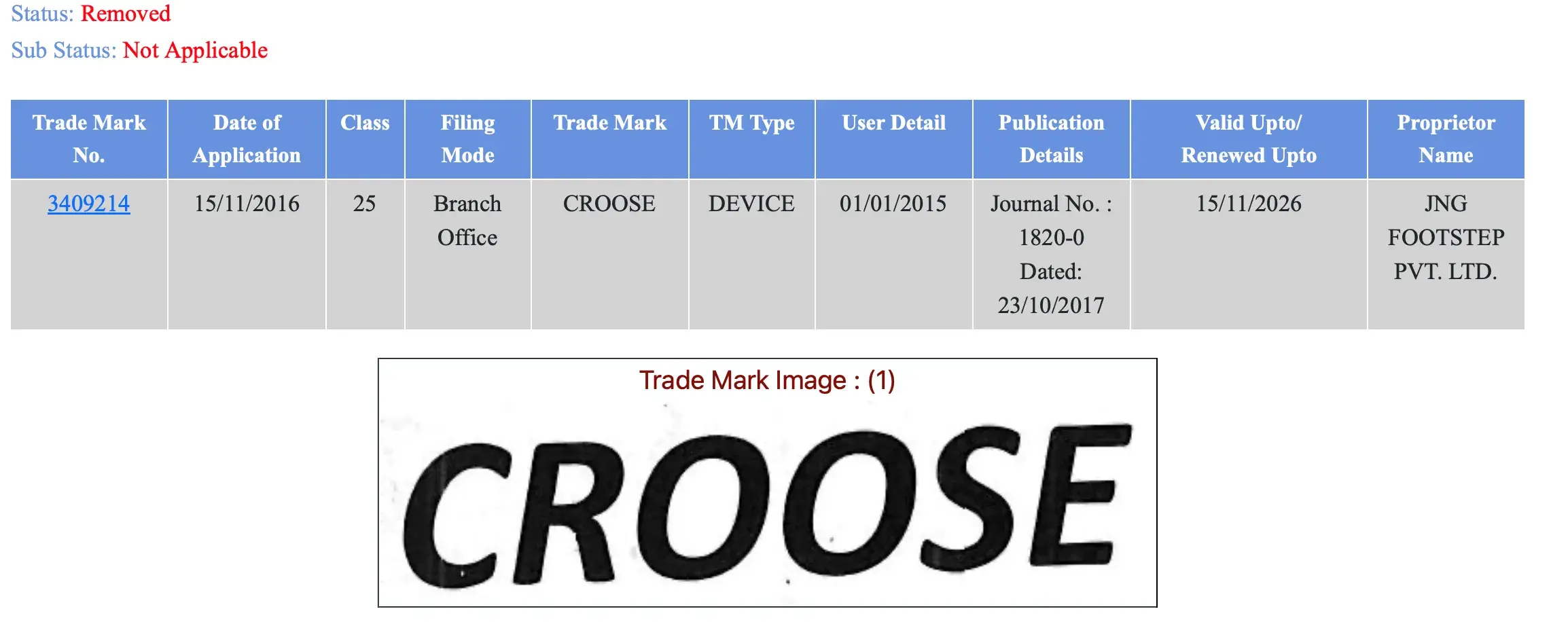
JNG Footstep Pvt. Ltd, a domestic footwear seller, obtained registration of the mark bearing Registration No. 3409214 in Class 25, which covers footwear, headgear, and clothing. Notably, the respondent had previously marketed its products under entirely different marks such as ‘JNG’, ‘AEROLITE’, and ‘RBS’ before switching to CROOSE. Crocs Inc. contended that this transition was deliberate and calculated to ride on its goodwill, making the adoption mala fide.
The petition was filed under Sections 47 and 57 of the Trade Marks Act, 1999. Despite multiple opportunities granted by the Court, JNG Footstep failed to file a written reply or written submissions. Consequently, its right to do so was formally closed by an order dated April 23, 2025.
Submission of the Parties
Petitioner’s Contentions:
The key contentions by Croc Inc.’s were priority and prior use, deceptive similarity of the marks, identical goods of the parties and malafide adoption by JNG Footstep.
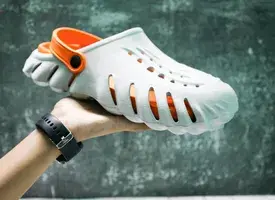
Crocs Inc. has been selling footwear under the CROCS mark in India since 2005-2006 and is the prior adopter of the mark, both globally and domestically. Further, the mark CROOSE/ is visually, phonetically, and structurally similar to CROCS wherein the lettering style and even the placement of the mark on the respective products are near-identical.
Further, since both the marks are registered and used for footwear falling within Class 25, unwary consumers are likely to be misled into believing that the JNG Footstep products originate from or are associated with Crocs Inc. In addition, JNG Footstep’s shift from its earlier marks (JNG, AEROLITE, RBS) to CROOSE reveals dishonest intent to trade on the Croc’s established goodwill.
As the registered owner of the CROCS mark in Class 25 and several other classes, Crocs Inc. clearly qualified as a ‘person aggrieved’ within the meaning of Section 57, giving it the locus standi to maintain the cancellation petition.
Respondent’s Arguments
In oral submissions, JNG Footstep argued that the name/mark CROOSE/ is structurally, phonetically, and visually distinct from CROCS. It was also contended that the registration of followed due process before the Trade Marks Registry and therefore could not be cancelled. However, given the failure to file substantive written submissions, their defence remained unsubstantiated on record.
Analysis and Findings of the Court
Visual, Phonetic and Structural Similarity of the Marks:
After examining images of both marks as they appear on the respective products, the Court found a striking degree of similarity. The placement of the mark on the footwear was found to be identical to that of CROCS. The overall visual appearance of was found to closely resemble CROCS, and the Court noted that both marks are phonetically similar, a consumer calling out for CROCS in a shop might easily be handed footwear bearing .
Identical Goods:
Both marks were being used for footwear registered under Class 25, making the goods not merely similar, but identical. This finding significantly strengthened Crocs Inc.’s case, since the bar for demonstrating likelihood of confusion is lower when the competing goods are identical.
Likelihood of Confusion:
The Court conclusively held that CROOSE/s is deceptively similar to CROCS and is likely to cause confusion among consumers and members of the trade. The impugned mark was therefore found to be hit by Section 11(1)(b) of the Act, which operates as an absolute bar against the registration of a mark that is deceptively similar to a prior registered mark for identical or similar goods.
Purity of the Register:
The Court invoked the well-established principle of maintaining the purity of the Trade Marks Register. The Register must not contain marks that are likely to mislead or deceive, and the Court held that permitting the mark CROOSE/ to remain on the Register would be contrary to this principle.
The Court allowed the petition in its entirety and directed the Trade Marks Registry to remove the mark CROOSE/ bearing Registration No. 3409214 in Class 25 from the Register of Trade Marks.
The Court further directed that the Register of Trade Marks be rectified accordingly and that the Registrar of Trade Marks website be updated within a period of four weeks.
The status of the application no. 3409214 for the mark as per the Trade Marks Registry is now ‘Removed’.
Conclusion
The Delhi High Court’s ruling in Crocs Inc. v. Registrar of Trademarks & Anr.[1] is a well-reasoned affirmation of core trademark principles. By holding to be deceptively similar to CROCS and directing its cancellation from the Register, the Court has upheld the integrity of India’s trademark system while safeguarding a globally renowned brand against deceptive imitation.
The Court’s operative finding rests on deceptive similarity under Section 11(1)(b)- visual, phonetic and structural resemblance, identical goods in Class 25. The judgment underscores that well-known international brands that establish their mark early in India through genuine commercial activity enjoy robust protection against copycats.
Indian trademark jurisprudence consistently applies the test of the average consumer with imperfect recollection, rather than the expert consumer conducting a careful side-by-side comparison. The Court’s reference to an ‘unwary class of consumers’ likely to be misled is consistent with this standard. When footwear sold under the name CROOSE is encountered at a retail outlet or online, the phonetically and visually similar mark can plausibly cause the ordinary buyer to assume an association with or origin from Crocs Inc.
The judgment stands as a significant precedent for future disputes involving phonetic and visual similarity, bad faith adoption, and rectification or cancellation of trademarks on the grounds of deceptive similarity under Sections 9, 11, and 57 of the Trade Marks Act, 1999. It reinforces the principle that maintaining the purity of the Trade Marks Register is a matter of public interest, and that courts will not hesitate to expunge deceptively similar or improperly registered marks that undermine the integrity of the Register.
For brand owners, this judgment affirms that registration at the Trade Marks Registry, even if obtained without opposition, is not unassailable when a well-known prior mark exists. For potential infringers, the case is a stark warning: the adoption of a mark that phonetically mimics a globally recognized brand, even with minor spelling variations will not survive legal scrutiny when the goods are identical and the adoption is clearly derivative.
[1] C.O. (COMM.IPD-TM) 82/2023 2023 & IA No. 3113/2023, 2025:DHC:8660, decided 26.09.2025 (Delhi HC, Tejas Karia, J.).