

By Lucy Rana and Abhishek Chandok
Bangladesh has emerged as a compelling trademark jurisdiction for both domestic entrepreneurs and multinational corporations. With over 170 million consumers, a booming garment and manufacturing sector, and a rapidly digitising economy, the country’s intellectual property landscape is at a pivotal moment and the 2024 WIPO data tells a story that every business owner and legal counsel should read carefully.
The Bangladesh IP Office recorded 12,010 total filings in the reporting period placing it 72nd globally while resident filings stood at 7,966. A dip of 7.2% in overall filings might, at first glance, appear discouraging. In reality, it signals something else entirely: a window of competitive advantage for brands that act now, before the market corrects upward.
Annual Trademark filing Trend (2015-2024)
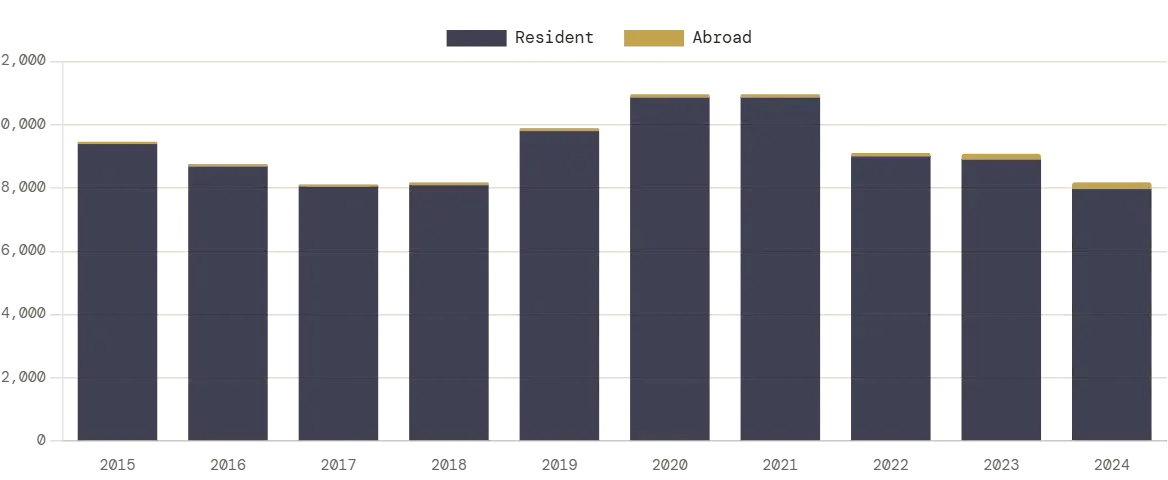
The bar chart above reveals a decade of trademark activity at the Bangladesh IP Office. Filings peaked at 10,964 in 2021 before moderating to 8,179 in 2024. The pattern mirrors post-pandemic normalization seen across Asian IP offices, and the historical baseline remains firmly above 2015–2017 levels evidence of structural growth, not decline. Abroad filings, though modest, climbed 15.8% year-on-year, reaching 213 and a global rank of 123rd a sign that international brand owners are increasingly looking inward to Bangladesh as a destination market.
Sector Spotlight: Where the Filings Are Concentrated
Understanding which sectors drive trademark activity is essential for any brand strategy. The Nice classification data from Bangladesh reveals a market dominated by food, consumer goods, and services precisely the sectors experiencing the most intense commercial activity in the country’s consumer economy.
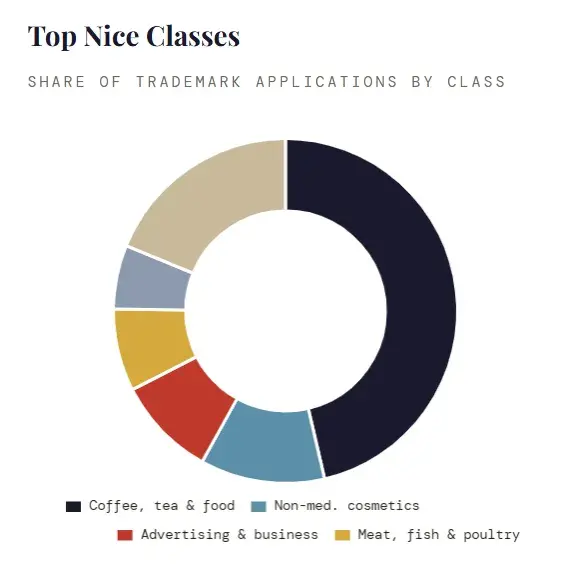
The leading Nice class Coffee, tea and food (46.3%) reflects Bangladesh’s robust food and beverage sector, where brand differentiation is intensely competitive. Non-medicated cosmetics (11.7%) and advertising/business management (9.4%) round out a top three that speaks to a consumer economy growing in sophistication. For any FMCG, retail, or service brand operating in or entering Bangladesh, these categories represent the highest-risk zones for trademark squatting and infringement.
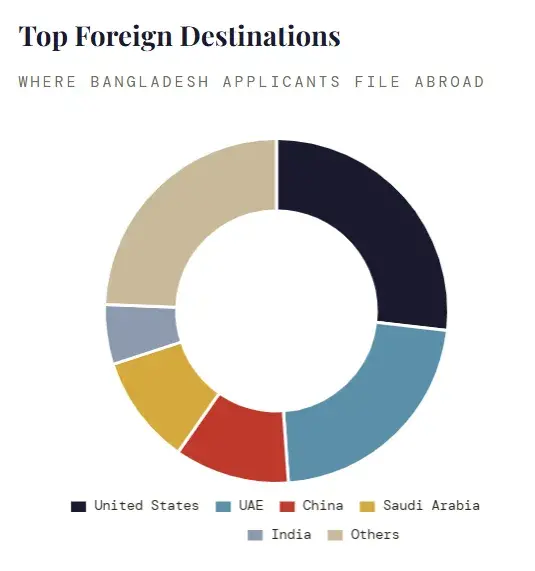
The foreign destinations chart is equally instructive. Of the 213 Bangladesh resident filings made abroad, 26.8% targeted the United States and 22.1% the United Arab Emirates revealing the geographic reach of Bangladeshi businesses and the corridors where brand conflicts most frequently arise. China (10.8%) and Saudi Arabia (10.3%) complete a picture of a commercially ambitious domestic industry filing in major trade partner markets.
If your business operates in food & beverage, cosmetics, or professional services and you trade with or in Bangladesh, you are operating in the highest-risk trademark classes without a filing in place. Every day without protection is a day a competitor can claim your brand.
Non-Resident Filings: Who Is Protecting Their Brand in Bangladesh?
The IP office received 4,044 non-resident filings representing 33.7% of total activity. The countries of origin paint a clear picture of global commercial interest in Bangladesh:
China leads with 954 filings (23.6%), followed by the United States at 498 (12.3%). Japan, India, and Germany complete the top five. The message is unambiguous: the world’s most commercially aggressive nations are actively protecting their intellectual property in Bangladesh. If your competitors from China or the US have already filed, a gap in your own trademark portfolio is an open invitation to infringement, brand confusion, and costly enforcement action.
The Case for Acting Now
The 25.3% increase in trademark classes specified in registrations is perhaps the most telling statistic in the entire dataset. This metric captures the breadth of protection sought by rights holders and it has grown sharply even as filing volumes moderated. Businesses are not filing less thoughtfully; they are filing more strategically, covering wider class ranges to build defensible IP portfolios.
With 45.9 resident filings per million inhabitants (ranked 107th globally) and 541 filings per 100 billion USD GDP (ranked 114th), Bangladesh remains significantly under-trademarked relative to its economic size. This disparity is both a risk and an opportunity: the risk is that brand identities are dangerously exposed; the opportunity is that the register still has room for first-mover advantage.
For further information, please contact us at foreign@ssrana.com
Our Coverage on LinkedIn: https://www.linkedin.com/feed/update/urn:li:activity:7470356653104816128