

By Ananyaa Banerjee, Siddhant Manchanda and Samridhi Chugh
Fashion’s Sustainability Problem: Rise of Upcycling
The fashion industry is one of the world’s biggest polluters, responsible for nearly 10% of the global greenhouse gas emissions[1], second only to the oil industry. Fast fashion, overproduction and quick waste disposal contribute significantly to environmental crises. In response, consumers, especially Gen Z, are demanding sustainable alternatives and encouraging brands to take action.
The most recent and most popular solution to the environmental problems, as a part of the emerging conversations on circular economy, is the practice of ‘upcycling’. Upcycling refers to the process of transforming old, discarded or surplus materials into new, higher value products, such as garments or accessories. Unlike recycling, which often breaks materials down into their raw components, upcycling creatively repurposes existing and used items without altering their basic structure, often enhancing their value. By repurposing materials like old jewellery, fabric, buttons, and accessories, upcycling has provided an eco-friendly alternative to the fashion industry.
While Indian fashion enthusiasts would be all too familiar with the highly artistic use of old, worn-out fabrics in traditional techniques like Kantha and Godhadi quilting, creation of Chindi rugs, and their repurposing for use as turbans, etc., this trend is also being picked up by various global fashion brands, striving to meet Environmental, Social and Governance (ESG) benchmarks. For instance, Gucci, through its initiative Gucci-Up, has begun to experiment with authorized upcycling.[2] Even Vogue has hailed upcycling as the “sustainable fashion trend of 2021” praising its role in reducing waste and fostering creativity.[3] This becomes even more pertinent in light of the fact that consumers across the world are willing to pay 9.7% increased prices for sustainably created products, as per a 2024 PwC survey.[4] The global second-hand and resale fashion market is expected to reach USD 393 billion by 2030 and is growing twice as fast as the overall apparel retail, according to ThredUp’s Annual Resale Report 2026.[5]
Upcycling, Fashion and IP
While upcycling offers a sustainable alternative in the fashion industry, it presents several IP-related issues that can complicate the creative reuse of original material. While the ecological practice leads to the creation of a materially transformed product, the original brand’s trade mark, trade dress, and in some jurisdictions, its copyright in design elements, remain affixed to it. The upcycler who cuts a Levi’s 501 into a patchwork jacket does not remove the Arcuate stitching. The atelier that reconstructs a YSL monogram handbag does not erase the interlocking logo. As upcycled fashion gains popularity, legal challenges arise primarily when designers retain brand names, logos or symbols of original products into their new creations.
In an era where sustainability is more than just a buzz word, the fashion industry faces a complex dilemma: How can it embrace eco-friendly practices without infringing on intellectual property rights? The dilemma becomes further convoluted when seen from the light of the First Sale doctrine in trade marks law, which, while on one hand, bars trade mark owners from preventing any further sale of their products after they are legitimately sold, on the other, becomes inapplicable in case there is any material alteration to the original product, such as in the case of upcycling.
The recent legal battle between the luxury brand CHANEL and upcycling brand SHIVER & DUKE captures this conflict between trade mark protection and the use of sustainable fashion alternatives. In this case, CHANEL sued the jewellery brand, SHIVER & DUKE, for incorporating authentic CHANEL buttons into their jewellery designs without authorization.
The Case: Chanel v. Shiver & Duke[6]
Parties
The Plaintiff, Chanel Inc., is a renowned luxury fashion house which offers a wide range of products including haute couture, clothing and beauty products.
The Defendant, Shiver & Duke LLC, is an independent upcycling jewellery brand.
Issue
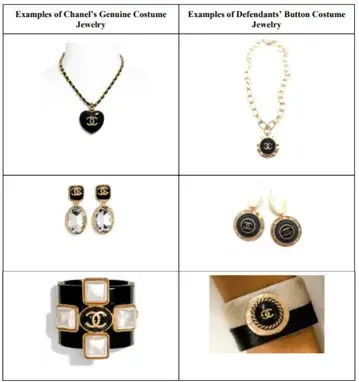
Shiver & Duke was accused by Chanel of using authentic CHANEL buttons bearing the CC monogram and repurposing them into costume jewellery, a creative move, however, without the authorization of Chanel. As per Chanel, these buttons were not intended to be used elsewhere other than on Chanel clothing. Furthermore, the repurposed costume jewellery created by Shiver & Duke appeared indistinguishable from those already sold by Chanel under its brand. A pictorial comparison of the costume jewellery being sold by the two parties has been provided below:[7]
Claims
Counsels for the Plaintiff:
- Trade Mark Infringement: Chanel’s counsels argued that the use of its signature buttons, featuring the iconic CC monogram, misled consumers into believing that these products were officially licensed or endorsed by Chanel, and thus, constituted trade mark infringement.
- Consumer Confusion: Chanel’s counsels claimed that buyers might assume these upcycled pieces were genuine Chanel jewellery, rather than reworked accessories. Further, Shiver & Duke did not include any clear disclaimer that they were not officially affiliated with Chanel, and therefore, could lead to confusion.
- Unfair Competition: It was stated that the Shiver & Duke’s use of Chanel’s marks was likely to cause deception as to the source of the goods, creating a false impression of their affiliation with Chanel, constituting unfair competition in violation of the provisions of the Lanham Act.
- Brand Dilution: Chanel’s counsels asserted that Shiver & Duke’s unauthorized use of its branded elements weakened the exclusivity and value of Chanel’s brand.
- Unauthorized Use of Intellectual Property: Chanel’s counsels contended that Shiver & Duke misused Chanel’s brand identity without permission. Consequently, they had issued a cease-and-desist letter demanding Shiver & Duke to discontinue the use.
Counsels for the Defendants:
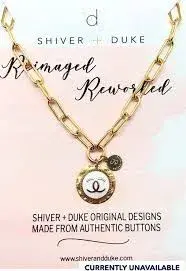
- Authenticity & Transparency: Shiver & Duke’s counsels argued that the buttons were 100% authentic Chanel components, legally required, repurposed and reworked.
- Clear Disclaimer: Shiver & Duke’s counsels argued that every product listing included a disclaimer clarifying no affiliation with Chanel. However, the same was contested by Chanel, as the said disclaimer merely ensued the incorporation of the terms ‘Reimagined’ and ‘Reworked’ instead of a clearer statement declaring non-affiliation with Chanel.
- Sustainability: The brand positioned itself as an eco-conscious innovator, aiming to balance fashion and luxury with environmental consciousness and waste reduction.
Decision[8]
On November 29, 2022, the US District Court entered a final judgment permanently restraining Shiver & Duke from using Chanel’s trade marks including the iconic CC monogram, in any form, even on genuine Chanel buttons repurposed, from selling or distributing any Chanel’s components without authorization, and making any reference, or using any false designation of origin, to Chanel in the media or amongst the public. Shiver & Duke was also directed to deliver up all jewellery bearing Chanel’s marks, and award Chanel damages and all gains as a result of their actions. This decision was largely based on the following rationale:
- Using Chanel’s trade marks on jewellery without permission was seen as likely to cause consumer confusion about whether Chanel had made, sponsored or authorized the products, thus leading to trade mark infringement.
- Using Chanel’s trade marks without authorization diluted the uniqueness and reputation of the brand.
- The First-Sale-Doctrine was not applicable in this case as it generally applies when genuine branded products are resold. However, in the present case, there was material modification of the case, and therefore, the doctrine did not apply.
While the parties, ultimately, settled the matter outside of the court, in 2022,[9] the case effectively reignited public discourse on the legality of upcycling in light of prevalent trade mark principles, including the First Sale doctrine.
Understanding the First-Sale-Doctrine and its Exceptions
The First Sale Doctrine allows the resale of trade marked products without the trade mark owner’s permission, provided the products remain unaltered. For example, if Shiver & Duke procured Chanel’s products legally and then simply resold it (even without Chanel’s permission), there would not have been an issue.
However, if the product is materially modified, the doctrine may not apply, and the resale could lead to infringement. For instance, in EU, while the initial sale of branded products within the European Economic Area can lead to the exhaustion of the trade mark owner’s rights in terms of those products, the owner may still challenge their further marketing or distribution if the condition of the products is materially modified.
What is “material modification” in this context?
It is when an upcycled product differs significantly from the original, especially in ways that could affect the product’s quality or brand perception and identity and may lead to consumer confusion regarding the origin. Since in the present case, Shiver & Duke used Chanel’s components to create a new product i.e., jewellery, they could not claim the defense available under First-Sale Doctrine/Doctrine of Exhaustion. This post-sale confusion theory, also known as ‘initial interest confusion’, focuses on the perception of consumers who encounter the upcycled product in the marketplace, not merely at the point of purchase.
As early as in the year 1947, the United States Supreme Court in the case of Champion Spark Plug Co. v. Sanders, 331 U.S. 125 (1947) observed that a defendant who reconditioned used spark plugs and resold them along with the “CHAMPION” mark did not infringe the trade mark, if adequate disclosure that the goods had been repaired or reconditioned was provided.[10] Further, the United States Court of Appeals, Eleventh Circuit, held in the case of Davidoff & CIE SA v. PLD International Corp., 263 F.3d 1297 (11th Cir. 2001), that, “The resale of a trademarked product that has been altered, resulting in physical differences in the product, can create a likelihood of consumer confusion. Such alteration satisfies the material difference exception and gives rise to a trademark infringement claim.”[11]
In the European Union, the exhaustion principle is codified in Article 15 of the European Union Trade Mark Regulation (EUTMR), Regulation (EU) 2017/1001,[12] and replicated in Article 15 of the Trade Mark Directive (EU) 2015/2436.[13] The principle is one of regional exhaustion: rights are exhausted within the EEA once goods are placed on the market by the rights holder or with their consent, but not upon first sale outside the EEA. Article 15(2) EUTMR, however, creates a critical exception that preserves the brand’s enforcement rights where goods have been altered or impaired after they were placed on the market.
Earlier, in the year 2013, Chanel had also filed a complaint against a similar jewellery company, Button Jewelry by Val Colbert, which, too, was offering jewellery pieces created out of repurposed Chanel buttons, but the matter eventually settled outside the court.[14] In May 2020, luxury brand Rolex successfully obtained an injunction preventing the use of its watches by the upcycling company La Californienne for customized re-selling.[15]
On April 10, 2025, the Paris Judicial Court ruled against a designer and her company for selling clothing made from “Hermès” scarves, citing copyright protections on the scarves’ motifs. The court rejected the defendants’ claim of lawful sales based on the First Sale doctrine, referencing a CJEU ruling that observed altered reproductions necessitate authorization.[16]
On July 2, 2025, the High Court of Singapore addressed a case involving the influencer “EMCASE SG,” who sold leather goods purportedly upcycled from Louis Vuitton products. The court ruled against the influencer for trade mark infringement, rejecting environmental ethics as a valid defense, and imposed a halt to the illicit activities alongside awarding damages to Louis Vuitton. [17]
Position in India on the First-Sale Doctrine
Copyright context- The First Sale Doctrine in India is embodied in Section 14 of the Copyright Act, 1957, which limits the copyright owner’s distribution rights once a copy of a work has been sold. Needless to say, the doctrine does not allow unauthorized copying or reproduction, only the resale or transfer of lawfully purchased copies.
Trade Mark context- Section 30(3) of the Trade Marks Act, 1999, encapsulates the First Sale Doctrine in respect of trade marks, and states that “(3) Where the goods bearing a registered trade mark are lawfully acquired by a person, the sale of the goods in the market or otherwise dealing in those goods by that person or by a person claiming under or through him is not infringement of a trade mark by reason only of…(b) the goods having been put on the market under the registered trade mark by the proprietor or with his consent.”
However, the doctrine is applied upon consideration of the condition of the goods sold/resold. It has been specifically provided in Section 30(4) of the Act that the First Sale doctrine “…shall not apply where there exists legitimate reasons for the proprietor to oppose further dealings in the goods in particular, where the condition of the goods, has been changed or impaired after they have been put on the market.”
This legal position stands reinforced by a slew of judicial mandates. In the case of Kapil Wadhwa & Ors. v Samsung Electronics Co. Ltd. & Anr. 2012 SCC OnLine Del 5172, the Court first held that, “…further dealing in the goods placed in the market under a trade mark can be opposed where legitimate reasons exist to oppose further dealing and in particular where the condition of the goods has been changed or impaired.” However, the Court in this case allowed the Appellant to re-sell the alleged imported products in India, albeit with the condition that appropriate disclaimers must be provided at the site of their sale clearly mentioning the fact that they were imported independently, and that the trade mark owner gives no guarantees/warranty in their respect and would not provide any after-sales service. Further, in the case of Patanjali Ayurved Limited v. Masala King Exports Trading Pvt. Ltd. & Ors. CS(COMM) 107/2019, the Hon’ble Delhi High Court clarified that the First Sale doctrine only applies if the goods are resold in the same condition as when first sold. Altering the product defeats the protection given by the doctrine and would constitute infringement.
More recently, in the case of Hershey Company v. Atul Jain trading as Akshat Online Traders, CS(COMM) 780/2023, the Hon’ble Delhi High Court, giving due regard to the aspect of consumer confusion and the consequent impact on public health and safety, observed, “6. ……………if a reseller alters a genuine article in a way that could mislead consumers—such as changing expiry dates—then this would undeniably create confusion about the source and quality of the goods. Such actions can be seen as creating a “materially different” product, which can fall outside the protection of the first sale doctrine and infringe upon the trademark. In these cases, consumers might believe they are buying a product which is backed by the original manufacturer’s reputation and assurances, when in fact they are not. Such misrepresentation has the potential of damaging the Plaintiff’s brand reputation, while also deceiving consumers and endangering public health. Such circumstances justify the grant of an injunction to prevent further misuse of the Plaintiff’s trademark and protect consumer safety.”
From the above, it is clear that the Indian position on First Sale doctrine and product upcycling is at par with the global stance, as captured in the decision in Chanel’s conflict. Proprietors in India retain their right to object to any unauthorized marketing of the goods bearing their mark even after the first sale, if they have legitimate reasons, including any material modification or alteration to the original product. The same can constitute trade mark infringement and/or passing off, because it interferes with the proprietor’s exclusive right to preserve the identity and quality of the goods.
Re-sale of materially modified goods bearing the same identifiers (e.g. a mark or brand) as that of the original goods without the provision of any disclaimer per se, not only dilutes the original brand’s distinctiveness but also harms public interest by misleading consumers, eroding public trust and potentially exposing them to substandard or unsafe products. Therefore, an upcycled product that clearly discloses its true nature and makes no affirmative claim of having been authorized by the original brand stands on stronger ground than one marketed as simply a by-product of the original brand.
Conclusion: Striking a Balance between Sustainability and IP Protection
The instant dispute between Chanel and Shiver & Duke exposes a recently emerging but recurring tension in fashion law: protecting a brand’s identity while also responding to growing sustainability concerns. Pertinently, recent developments in Europe have also begun zooming in on the significance of repair and recycle as a part of efforts towards waste minimization. The EU’s Right to Repair Directive[18] establishes consumer rights to repair and reuse goods, superseding the restrictions imposed by manufacturers, with the aim of reducing waste and extending product lifespans. Additionally, France’s AGEC Law[19] bans destruction of unsold goods, forcing brands to channel them into reuse or recycling streams. While the aforesaid statutes remain silent on IP-related restrictions on repair and refurbishments, such as the first-sale doctrine and material alteration exception, these developments indicate that space is emerging in the global policy and legislative discourse where IP specific conflicts can expect to achieve some substantial redressal.
Further, while cases pertaining to the conflict between IP and upcycling have not yet begun to emerge at the domestic front, it is quite clear from the aforesaid discussion that the law, both in India and abroad, tends to heavily lean towards safeguarding trade marks, because, at the end of the day, consumer trust and brand reputation form the backbone of IP law.
The solution lies in moving away from confrontation and towards innovation and collaboration. At the onset, brands may enhance sustainability measures through a multitude of in-house initiatives, such as the effective use of surplus or deadstock material to transform the bulk of old and unsold products into fashionable merchandise. Further, use of organic or recycled fabrics to ensure the creation of sustainable garments from the very get, along with adoption of in-store resale and repair models can also optimize the needs of the industry to reduce waste reduction and achieve environmental goals.
Gucci’s “Off the Grid” fashion collection, launched in 2020, which comprises readymade garments, footwear and accessories, prepared using recycled and sustainably sourced raw material[20] proves that innovation in luxury fashion can co-exist with eco-conscious practices. After all, fashion today is not just about exclusivity, it is also about responsibility.
Upcycling by third-party upcyclers may still be allowed a green-flag, provided they adhere to a clear disclosure protocol with prominent disclaimers identifying products as upcycled from original branded goods. Further, such initiatives can also get their due space through authorized collaborations, partnerships, licensing and other synergistic undertakings that strike a balance between rights protection and environmental sustainability. Since there exist areas of conflicts between IP and sustainability, suitable collaborative measures such as resale and repair can be adopted by brands, who can authorize upcycling collaborations with resale partners or third-party upcyclers while continuing to retain their IP. Additionally, a certification system for recycled products could encourage customers to purchase sustainable products consciously.
The recent Adidas X Gucci collaboration, which reimagined classic Adidas designs through Gucci’s luxury lens, serves as an ideal example of collaboration for the environmental cause.[21] This partnership demonstrates that when brands collaborate, they can innovate sustainability while respecting each other’s IP. By working together, brands can create unique products that honor their heritage and appeal to environmentally conscious consumers.
Our Coverage on LinkedIn: https://www.linkedin.com/feed/update/urn:li:activity:7490659757876269056
[1] https://earth.org/fast-fashions-detrimental-effect-on-the-environment/
[3] https://www.istitutomarangonimiami.com/blog/fashion-trends-2021-the-year-of-sustainability/
[4] https://www.pwc.com/gx/en/news-room/press-releases/2024/pwc-2024-voice-of-consumer-survey.html
[6] Chanel, Inc. v. Shiver and Duke, LLC, No. 1:21-cv-01277-MKV (S.D.N.Y. Nov. 29, 2022)
[7] https://storage.courtlistener.com/recap/gov.uscourts.nysd.554187/gov.uscourts.nysd.554187.1.0.pdf
[8] https://www.courtlistener.com/docket/59248740/chanel-inc-v-shiver-and-duke-llc/
[10] https://caselaw.findlaw.com/court/us-supreme-court/331/125.html
[11] https://law.justia.com/cases/federal/appellate-courts/F3/263/1297/533663/
[12] https://eur-lex.europa.eu/legal-content/EN/TXT/PDF/?uri=CELEX:32017R1001
[13] https://eur-lex.europa.eu/eli/dir/2015/2436/oj
[15] https://docs.justia.com/cases/federal/district-courts/california/cacdce/2:2019cv09796/764739/33
[17] https://www.elitigation.sg/gd/s/2025_SGHC_122
[18] Directive (EU) 2024/1799, entered into force 31 July 2024, accessible from https://eur-lex.europa.eu/legal-content/EN/TXT/?uri=CELEX%3A32024L1799
[19] Anti-gaspillage pour une économie circulaire, Law No. 2020-105 of 10 February 2020 (https://climate-laws.org/document/law-n-deg-2020-105-of-10-february-2020-relating-to-the-fight-against-waste-and-the-circular-economy_325b)
[21] https://news.adidas.com/originals/adidas-x-gucci-is-here/s/73828335-7f0b-4f46-8d9a-ba0af35277c5