

By Lucy Rana and Huda Jafri
INTRODUCTION
Can a beauty brand own the phrase “glass skin”? In Renee Cosmetics Pvt. Ltd. v. Rupali Sharma & Anr.[1], the Delhi High Court held that it cannot. “Glass Skin,” the K-beauty term for a poreless, dewy, luminous complexion, describes a cosmetic outcome rather than a commercial source, the Court found, and so cannot be monopolised as a trademark. It ordered cancellation of the registered “Glass Skin” mark in Class 3, holding that the phrase tells consumers what a product promises to deliver, not who makes it. The ruling is a useful marker for brand owners in trend-driven sectors such as beauty and wellness, where popular buzzwords are often mistaken for ownable brand assets.
BACKGROUND OF THE DISPUTE
The dispute traces the following timeline:
| Date | Development | Significance |
| 2 May 2019 | Respondent no. 1 applies to register the word mark “Glass Skin” in Class 3 for cosmetics, on a “proposed to be used” basis; the mark is registered. | Establishes the respondent’s exclusive claim over the phrase. |
| From October 2019 | Renee Cosmetics is incorporated and later launches its own cosmetics and skincare range. | Renee begins using industry-standard beauty terminology in the same market. |
| January 2025 | Renee applies to register “Renee Glass Skin SPF 50” for sunscreens. | Triggers the respondent’s objection. |
| March 2025 | The respondent issues a notice alleging infringement of her “Glass Skin” registration. | The dispute becomes formal. |
| October 2025 | Renee’s product listings are reportedly removed from Amazon on a complaint based on the registration. | The commercial impact of the registration becomes concrete. |
| 2025 | Renee applies for rectification and cancellation of the registration before the Delhi High Court under Sections 47[2] and 57[3] of the Trade Marks Act, 1999. | Sets up the registrability question decided in this Alert. |
| 5 June 2026 | The Delhi High Court cancels the “Glass Skin” registration. | Subject of this Article. |
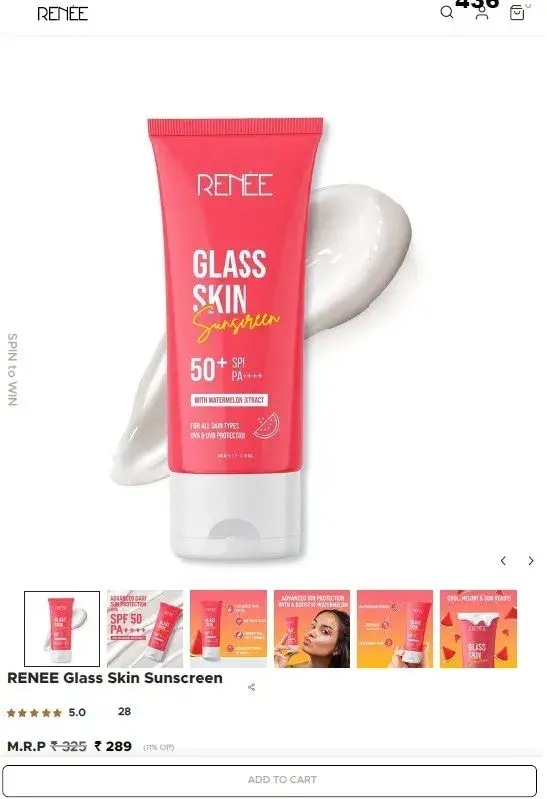
Renee’s “Glass Skin Sunscreen” product page, reproduced in the judgment, showing the composite mark “RENEE Glass Skin Sunscreen” at the centre of the dispute.
THE PARTIES’ SUBMISSIONS
- Renee’s Submissions
“Glass Skin,” Renee argued, is a common, long-standing term in the international cosmetics market, describing skin that is translucent, bright and luminous. Though the expression originated in South Korea, it had entered everyday cosmetics vocabulary well before the respondent’s 2019 filing. Renee produced extensive evidence that brands including Lakme, Nivea, Garnier, Vaseline, L’Oréal and Mamaearth used “Glass Skin” generically, to describe the end result of a skincare regime rather than its commercial source.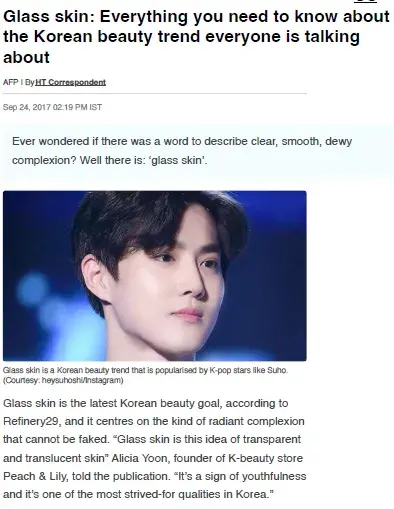
Hindustan Times, 24 September 2017: evidence placed on record by Renee showing that the Korean “glass skin” trend was public knowledge well before the respondent’s 2019 application.[4]
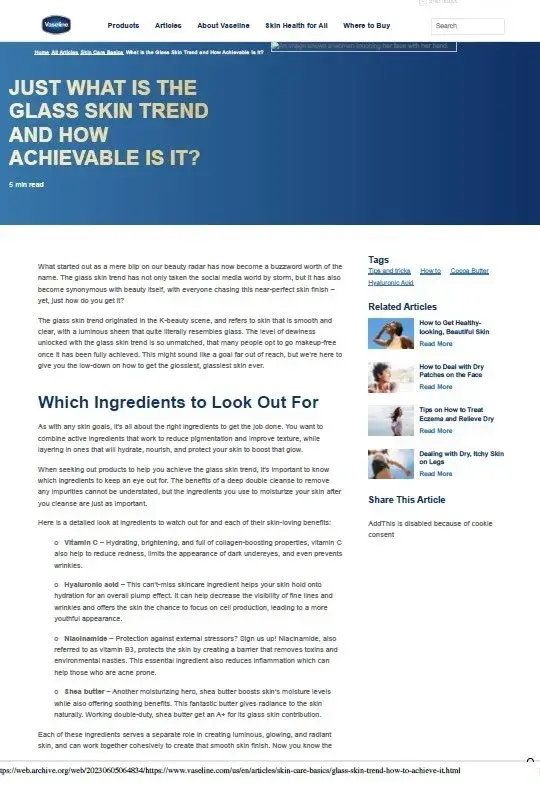
Vaseline’s article on the “glass skin” trend, part of the third-party material Renee submitted to prove industry-wide descriptive use.[5]
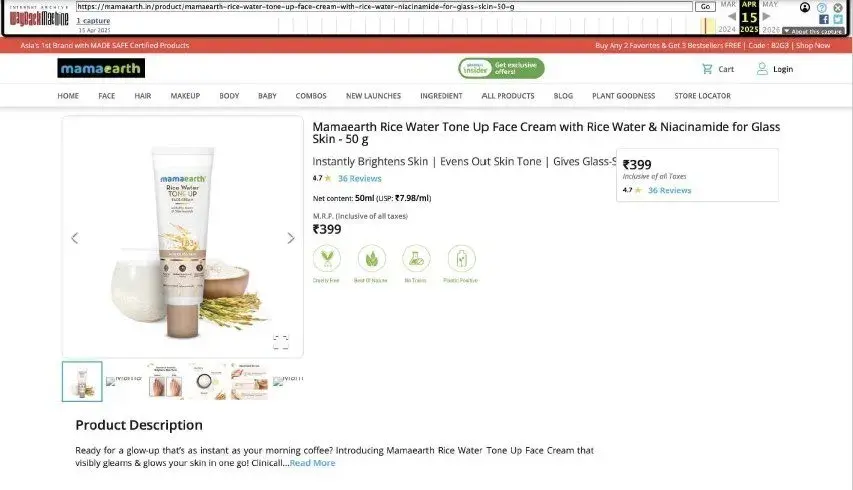
Mamaearth’s listing for a face cream “for Glass Skin,” further evidence that rival brands use the term to describe a promised result, not a brand.[6]
Renee also pointed to the respondent’s own website, which described “Glass Skin” as “the most popular Korean beauty technique to get illuminating, flawless and transparent skin like glass,” language describing an effect, not a source. Crucially, Renee argued, the respondent had shown no acquired distinctiveness: no evidence that the public associated “Glass Skin” with a single trader rather than the market at large.
- Respondent’s Submissions
The respondent countered that “Glass Skin” is suggestive, not descriptive: it does not describe the product’s ingredients, formulation or characteristics, but requires an imaginative leap by the consumer, the hallmark of a suggestive mark entitled to protection without proof of acquired distinctiveness. She further argued that her use of the mark had been continuous since 2019, and that Renee, itself seeking to register a mark containing “Glass Skin,” could not challenge its validity while doing so, an objection of approbation and reprobation.
THE COURT’S ANALYSIS
- Descriptive versus Suggestive Marks
Hon’ble Justice Tushar Rao Gedela examined the distinction between descriptive and suggestive marks, drawing heavily on the treatise McCarthy on Trademarks and Unfair Competition. Trademarks fall along a spectrum of protection: arbitrary and fanciful marks receive the strongest protection, followed by suggestive marks; descriptive marks are weakly protected absent proof of secondary meaning, and generic marks receive almost none. A mark is descriptive, on this spectrum, if it refers to the nature or purpose of the goods, their intended use, their qualities, or the result they produce.The record showed “Glass Skin” used across the cosmetics industry to denote a beauty goal, including, the Court noted, by the respondent herself, on her own website and marketing material. No imaginative leap was required: an average consumer encountering “Glass Skin” on a cosmetic product would simply understand it to promise the popular “glass skin” look. Nor had the respondent shown that the mark had acquired secondary meaning through use, advertising or consumer recognition, without which a descriptive mark cannot remain on the register. - Section 9(1)(b) and the Fate of the Registration
The registration also fell foul of Section 9(1)(b)[7] of the Trade Marks Act, 1999, which bars registration of marks designating the kind, quality, purpose or characteristics of goods or services. The Court found that “Glass Skin” described both the quality of the product and its promised effect, and was therefore wrongly registered. It directed the Registrar of Trade Marks to withdraw the mark from the register within four weeks.
KEY TAKEAWAYS
For Brand Owners
- Invest in marks that are inherently distinctive, coined, arbitrary or genuinely suggestive, rather than in the vocabulary of the moment; descriptive terms offer little to no protection absent proven secondary meaning.
- Before adopting a trending phrase as a brand name, check how widely it is already used descriptively across the industry; such use can defeat a later infringement claim even against a registered mark.
- If challenged over use of a popular but arguably descriptive term, consider rectification and cancellation proceedings under Sections 47 and 57 of the Trade Marks Act, 1999, rather than conceding the point.
For the Cosmetics and Beauty Industry
- Marketing copy matters: describing a product’s effect in the same language used to register it as a trademark can itself become evidence of descriptiveness, as it did for the respondent here.
- Platform takedowns based on a trademark registration can be challenged where the underlying mark is vulnerable to cancellation; act quickly to preserve listings and evidence.
For Trademark Applicants Generally
- Popular hashtags and beauty or lifestyle buzzwords are especially exposed to descriptiveness objections; genericness can attach almost as quickly as virality itself.
CONCLUSION
“Glass Skin” began as a beauty aspiration, and it will not end as one trader’s private property. The ruling reaffirms a first principle of trademark law: protection belongs to indicators of commercial source, not to the everyday vocabulary of a trade. In fast-moving sectors like beauty and wellness, where buzzwords turn generic almost overnight, the temptation to fence off a trending phrase is real; this judgment shows such claims will be closely scrutinised wherever the term simply describes a quality, characteristic or desired result. For the cosmetics industry and its consumers, “Glass Skin” stays exactly where it belongs: in everyone’s hands, not under one trader’s exclusive ownership.
[1] Renee Cosmetics Private Limited v. Ms. Rupali Sharma & Anr., C.O. (COMM.IPD-TM) 107/2025 (Delhi High Court, judgment dated 05.06.2026), 2026:DHC:5075.
[2] Section 47, The Trade Marks Act, 1999 (removal of a trademark from the register and imposition of limitations on the ground of non-use).
[3] Section 57, The Trade Marks Act, 1999 (power to cancel or vary registration and to rectify the register).
[4] “Glass skin: Everything you need to know about the Korean beauty trend everyone is talking about,” Hindustan Times, 24 September 2017.
[5] “Just What Is the Glass Skin Trend and How Achievable Is It?,” Vaseline (via Wayback Machine archive, captured 15 April 2021).
[6] Mamaearth, product listing for “Rice Water Tone Up Face Cream with Rice Water & Niacinamide for Glass Skin,” mamaearth.in (archived).
[7] Section 9(1)(b), The Trade Marks Act, 1999 (absolute grounds for refusal of registration).
Our Coverage on LinkedIn:
https://www.linkedin.com/feed/update/urn:li:activity:7503694945057181696