
By Rupin Chopra and Huda Jafri
Write “Globe” in Tamil and the alphabet changes, but the globe on the padlock, and the word a customer says aloud at the counter, stay exactly the same. That simple market reality underpinned a recent ruling in which a Chennai-based defendant sought to shelter behind a Tamil-script rendering of “Globe” on padlocks bearing a globe emblem strikingly similar to that of a Shanghai lock maker’s registered “GLOBE” brand.
Can a brand escape a trademark dispute simply by changing its language? The Madras High Court has said no, at least at the interim stage, refusing to lift an injunction against the use of a Tamil-script “Globe” mark that was found prima facie similar in appearance and pronunciation to the plaintiffs’ “GLOBE” branding.
In Vikas Mandoth v. Shanghai Huanqiu Lock Making Company Ltd. & Anr., Justice K. Kumaresh Babu, by order dated 7 September 2026, dismissed two applications filed by Vikas Mandoth seeking to vacate the ex-parte interim injunctions granted on 28 November 2025 in C.S. (Comm. Div.) No. 307 of 2025, a commercial suit instituted by Shanghai Huanqiu Lock Making Company Ltd. and Valaram, proprietor of Prince Impex.
The plaintiffs alleged that Mandoth was using a mark resembling their “GLOBE” marks, registered in China, on padlocks and other hardware products. They relied on their prior use, reputation and goodwill, and also alleged copyright infringement involving the associated artwork, trade dress and colour combination.
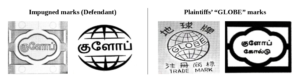
The marks at the centre of the dispute: the defendant’s impugned Tamil-script marks (left) and the plaintiffs’ “GLOBE” marks (right), as reproduced in the prayer in O.A. No. 1120 of 2025. Source: Order of the Madras High Court dated 07.09.2026 in A. Nos. 446 & 447 of 2026.
At the heart of the dispute was whether the difference in script was enough to distinguish the defendant’s branding from the mark on which the plaintiffs relied.
The plaintiffs pointed out that, while granting the ex-parte injunction, the Court had already recorded a categorical finding that, even on a simple scrutiny of the rival marks, the defendant’s use was identical and deceptively similar to theirs. They also highlighted that the defendant’s own trademark application stated that the mark was “proposed to be used”, which, according to them, contradicted his claim to be a prior user.
The Defence: A Different Script, Independent Adoption?
Mandoth argued that his trade name had been conceived through an independent and deliberate process, keeping in mind the nature and function of the goods, and that, having secured registration of “Globe” in Tamil for his device, he could not be restrained from using it. He also challenged the maintainability of the suit and alleged that the plaintiffs’ supporting documents were fabricated, pointing to the interchangeable use of “Chennai” and “Madras” in their invoices. He also contended that the plaintiffs had not complied with the pre-institution mediation requirement under section 12A of the Commercial Courts Act, 2015. He further argued that the plaintiffs could not claim exclusive ownership over a mark that was generic in nature, and that the suit stemmed from commercial enmity between the second plaintiff and himself, with the second plaintiff persuading the first plaintiff to institute the suit.
The defendant’s objections therefore extended beyond the similarity between the marks to the plaintiff’s entitlement to maintain the suit and the reliability of the evidence supporting their claims.
The Court’s View: Similarity Goes Beyond Language
The court found prima facie that the plaintiffs were prior users of the “GLOBE” mark and had produced material supporting reputation and goodwill in the market. It also observed that Mandoth’s trademark application, filed in 2023, described the mark as “proposed to be used”, a detail relevant to his claim of prior use. Opposition and rectification proceedings concerning his mark, initiated by the plaintiffs, were also pending before the Trade Marks Registry.
Addressing the defendant’s reliance on his Tamil registration, the Court accepted that registration gives its proprietor a right to use the mark, but noted that the very same statute also enables a registered mark to be rectified or removed from the register, and such proceedings against the defendant’s mark were already pending.
The Court also took note of the procedural history of the suit: summons had been served on him as early as 11 December 2025, his application to reject the plaint had been dismissed on 23 March 2026, and no written statement had been filed within the time stipulated under the Commercial Courts Act.
The significance of the Court’s observation was that the use of a different script did not, on its own, resolve the dispute in the defendant’s favour. The competing claims of prior use, together with the alleged visual and phonetic similarities, remained material to the Court’s assessment.
In its key observation, the Court held that the defendant’s attempt to use a phonetically and visually similar trademark/device “however, in a vernacular language would not entitle him to infringe the trademark of the plaintiff which had been established to have a good reputation and good will.”
The Outcome: Injunctions Remain in Place
Finding insufficient grounds to vacate the existing injunctions, the Court dismissed Mandoth’s applications, made the injunction in O.A. No. 1120 of 2025 absolute, and allowed the copyright-related application in O.A. No. 1121 of 2025, with no order as to costs.
The Court left the objections concerning maintainability and the alleged fabrication of documents for determination at trial. The order concerns interim relief and does not represent a final adjudication of all issues in the dispute.
The decision reinforces the importance of examining the overall impression created by a competing mark, rather than treating a change in language or script as sufficient to distinguish it from an existing brand.
The Takeaway: A New Script Is Not a New Brand
In a country where the same product may be sold under English, Tamil and many other scripts, the order carries a simple message: trademark protection does not stop where the English alphabet ends. Buyers recognise brands by what they see and what they say, and a mark that looks and sounds like an established brand does not become distinct merely because it is written in another script.
For businesses adopting regional-language marks, the lesson is to clear them against existing brands across languages and scripts, and to keep reliable records of adoption and use, because, as this case shows, an application that describes a mark as “proposed to be used” can undercut a later claim of prior use. For brand owners, timely opposition and rectification proceedings, backed by evidence of prior use and goodwill, remain the strongest shield. A globe, after all, remains a globe, whatever the script.
Aysha Sasmin, Intern at S.S. Rana & Co. has assisted in the research of this article.